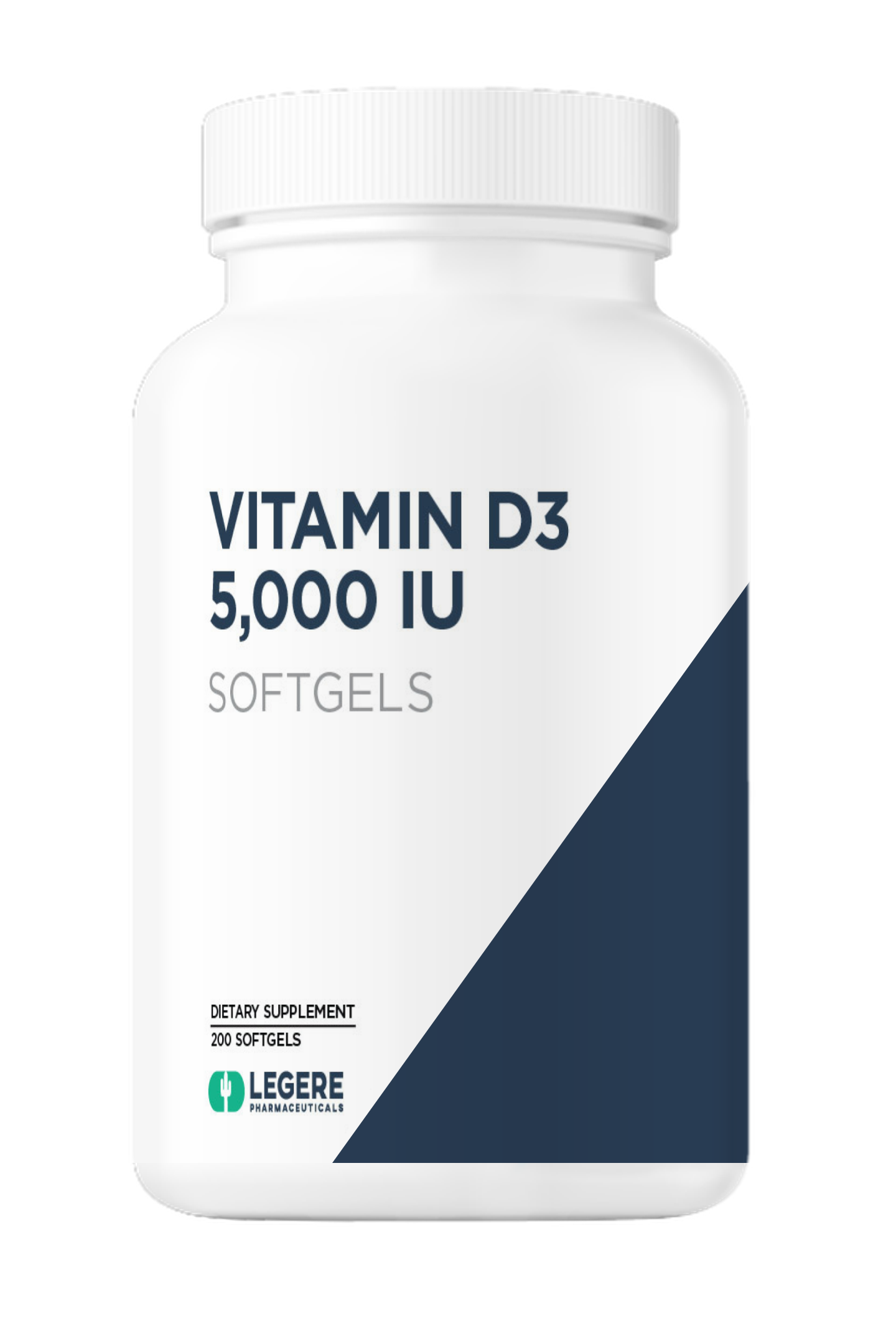
Vitamin D3 5,000 IU softgels — 125mcg D3 Cholecalciferol from Lanolin per softgel in an Extra Virgin Olive Oil and Safflower Oil base. High-potency bone health, immune function, and systemic wellness support.
Vitamin D3 5,000 IU delivers 125mcg of cholecalciferol per softgel — the same form of vitamin D the body produces naturally from sunlight exposure, and the most bioavailable form for supplementation. At 5,000 IU per softgel, this is a high-potency therapeutic formula designed for practices managing patients with confirmed or suspected vitamin D deficiency, or whose clinical protocols require meaningful vitamin D repletion beyond what standard 1,000-2,000 IU supplements provide. The single-ingredient formula uses an Extra Virgin Olive Oil and Safflower Oil base to support fat-soluble absorption, and a BSE-free bovine gelatin softgel for quality and purity.
| Specification | Detail |
|---|---|
| Active ingredient | Vitamin D (as D3 Cholecalciferol from Lanolin) |
| Dose | 125 mcg (5,000 IU) per softgel — 625% Daily Value |
| Softgels per bottle | 200 |
| Oil base | Extra Virgin Olive Oil and Safflower Oil |
| Softgel shell | Bovine gelatin (BSE-free), glycerin, water |
| Suggested use | 1 softgel daily with a fat-containing meal, or as directed by healthcare provider |
| Private label | Available |
Legere supplies licensed medical practices with a range of quantities to fit your volume needs. To get pricing, check availability, or place an order, click Request a Quote above or contact our team directly. Private label options are available on select products.
Vitamin D supplements come in two forms. D2 (ergocalciferol) is plant-derived and less efficiently converted by the body. D3 (cholecalciferol) is the form the skin produces when exposed to sunlight and is significantly more effective at raising and maintaining serum 25(OH)D levels. Research consistently shows D3 is two to three times more potent than D2 at raising blood vitamin D levels per unit of dose. Legere’s formula uses D3 Cholecalciferol from Lanolin — the standard high-quality D3 source — in the most clinically effective form.
The 5,000 IU dose: Standard over-the-counter vitamin D supplements typically deliver 1,000–2,000 IU. For patients with confirmed deficiency, limited sun exposure, malabsorption conditions, obesity, or elevated clinical needs — including post-menopausal women, older adults, patients on corticosteroids, and those with conditions linked to low vitamin D — 5,000 IU provides a therapeutic repletion dose under physician direction. Research on vitamin D sufficiency in clinical populations consistently supports higher daily intake than standard doses to maintain adequate serum levels.
Fat-soluble absorption: Vitamin D is fat-soluble — it requires dietary fat present in the GI tract at the time of ingestion to be absorbed into the lymphatic system. Taking vitamin D on an empty stomach significantly reduces absorption. Legere’s formula addresses this at the product level by using an Extra Virgin Olive Oil and Safflower Oil base inside the softgel — providing fat in the same capsule to support absorption even if the patient does not have a fat-containing meal. The recommended practice of taking with a fat-containing meal provides additional absorption support.
Vitamin D functions as a hormone rather than a traditional vitamin — it binds to receptors in virtually every tissue in the body and regulates hundreds of genes. Its best-established clinical roles:
Calcium absorption and bone health: Vitamin D is the primary regulator of calcium absorption in the intestines. Without adequate vitamin D, the body cannot absorb dietary calcium efficiently regardless of intake — making vitamin D a foundational requirement for any bone health protocol. It also regulates parathyroid hormone, which controls bone mineral resorption.
Immune system regulation: Vitamin D receptors are present on virtually every immune cell. Adequate vitamin D supports both innate and adaptive immune function — deficiency is associated with increased susceptibility to infection and dysregulated immune responses.
Muscle function: Vitamin D supports muscle protein synthesis and neuromuscular function. Deficiency contributes to muscle weakness, reduced physical performance, and increased fall risk — particularly in older adults.
Mood and neurological health: Vitamin D receptors are present throughout the brain. Low vitamin D levels are consistently associated with increased risk of depression, seasonal affective disorder, and cognitive decline. Supplementation in deficient individuals supports mood and neurological function.
Cardiovascular health: Vitamin D influences blood pressure regulation, vascular smooth muscle function, and inflammatory pathways involved in cardiovascular disease risk. Low vitamin D is an independent risk factor for cardiovascular events in multiple large epidemiological studies.
Hormone synthesis: Vitamin D is a precursor to steroid hormone synthesis and supports testosterone production in men. It also plays a role in estrogen metabolism — making it relevant in BHRT and hormone optimization contexts beyond bone health alone.
Vitamin D deficiency is among the most common nutritional deficiencies globally, affecting an estimated 40–70% of adults in the United States depending on the population studied. Key risk factors — all common in medical practice patient populations:
For practices that screen vitamin D levels — or that serve populations with high deficiency rates — having a high-potency, reliable D3 supplement available for direct dispensing means patients get immediate access to repletion rather than navigating retail supplement choices of variable quality.
BHRT and women’s health practices: Estrogen supports calcium retention and bone density — its decline at menopause accelerates bone loss. Vitamin D3 is essential for calcium absorption, making it a foundational companion to both Calcium Magnesium supplementation and estrogen therapy for postmenopausal bone health. Many BHRT practices measure 25(OH)D as part of their standard hormone panel and use D3 5,000 IU to correct deficiency before or alongside hormone protocols.
TRT and men’s health practices: Vitamin D supports testosterone synthesis — low vitamin D is independently associated with low testosterone in men. Supplementing to sufficiency as part of a hormone optimization protocol addresses this nutritional driver alongside the hormonal interventions.
Medical weight loss and GLP-1 practices: Obesity is a major vitamin D deficiency risk factor — adipose tissue sequesters vitamin D, reducing circulating levels. As patients lose weight, vitamin D status may improve but monitoring and supplementation is clinically prudent throughout active weight loss. GLP-1-driven reduced food intake may also lower dietary vitamin D.
Functional and integrative medicine practices: Vitamin D testing and repletion is one of the most common and high-value interventions in functional medicine — supporting immune function, mood, metabolic health, and inflammation reduction across virtually all patient presentations.
Longevity and anti-aging practices: Vitamin D deficiency accelerates multiple aging processes — bone density loss, immune decline, muscle weakness, cardiovascular risk, and cognitive impairment. Maintaining vitamin D sufficiency is one of the most evidence-backed and cost-effective longevity interventions available.
Pain management and orthopedic-adjacent practices: Vitamin D deficiency causes musculoskeletal pain that is often mistaken for fibromyalgia or arthritis. Correcting deficiency can meaningfully improve musculoskeletal pain in patients without another clear cause.
Calcium Magnesium Tablets — The most natural pairing in the catalog. Vitamin D3 drives calcium absorption in the intestines; without adequate vitamin D, calcium supplementation has significantly reduced effectiveness. Together they provide the complete bone mineral and absorption foundation. Any bone health protocol should include both.
Omega 3 Softgels — For comprehensive cardiovascular, bone, immune, and anti-inflammatory support. Omega-3s and vitamin D address overlapping and complementary aspects of systemic health — cardiovascular aging, inflammation, immune function, and metabolic health.
DHEA 25mg Capsules — For BHRT and hormone optimization practices. DHEA supports adrenal hormone production; vitamin D supports hormone synthesis and the hormonal milieu broadly. A natural pairing in comprehensive anti-aging and hormone support protocols.
Stress & Adrenal Support Caps — Chronic stress and elevated cortisol suppress immune function — vitamin D supports immune regulation through a complementary, independent pathway. For practices managing both stress physiology and immune health.
Fat-soluble and accumulates: Unlike water-soluble vitamins, vitamin D is stored in fat tissue and can accumulate to toxic levels with prolonged excessive dosing. At 5,000 IU daily under physician direction, toxicity risk is very low for most adults — research supports this dose as safe for extended use in the context of confirmed deficiency or elevated need. However, routine monitoring of serum 25(OH)D levels is appropriate for patients on ongoing high-dose vitamin D supplementation to confirm they are reaching sufficiency without exceeding it.
Hypercalcemia: Vitamin D toxicity produces hypercalcemia — elevated blood calcium — as its primary mechanism of harm. Symptoms of vitamin D toxicity include nausea, weakness, frequent urination, and kidney stones. These occur at serum levels well above those achieved at 5,000 IU daily in most patients, but monitoring is prudent with long-term high-dose use.
Granulomatous conditions: Conditions like sarcoidosis, tuberculosis, and certain lymphomas cause dysregulated vitamin D metabolism, leading to elevated active vitamin D and hypercalcemia. Vitamin D supplementation should be used with caution and physician oversight in these patients.
Thiazide diuretics: The combination of thiazide diuretics and high-dose vitamin D can increase calcium levels. Monitor serum calcium in patients on thiazide diuretics who are also supplementing with D3.
Bovine gelatin capsule: Not appropriate for patients who avoid bovine-derived gelatin for dietary, religious, or personal reasons.
These statements have not been evaluated by the Food and Drug Administration. This product is not intended to diagnose, treat, cure, or prevent any disease.
How do I order, and what quantities are available?
Contact our team directly to place an order or request a quote. We supply a range of quantities depending on the product — reach out for current availability, lead times, and volume pricing. Private label options are available.
Why 5,000 IU instead of a standard 1,000 or 2,000 IU dose?
Standard doses are appropriate for maintenance in patients who are already vitamin D sufficient. For the large proportion of patients who are deficient — estimated at 40–70% of U.S. adults — 1,000–2,000 IU is often insufficient to raise serum 25(OH)D levels to the range associated with clinical benefit. 5,000 IU under physician direction is a well-studied repletion dose for deficient adults that consistently produces meaningful improvements in serum levels without approaching toxicity thresholds.
Why must vitamin D be taken with food containing fat?
Vitamin D is fat-soluble — it is absorbed through the intestinal lymphatic system alongside dietary fat. Without fat present at the time of ingestion, a significant portion of the dose passes through unabsorbed. Legere’s Vitamin D3 uses an olive oil and safflower oil base inside the softgel to support absorption, but taking with a fat-containing meal further ensures optimal uptake.
How does vitamin D relate to calcium supplementation?
Vitamin D is the primary hormonal regulator of calcium absorption in the intestines. Adequate vitamin D is what allows the body to absorb calcium from food and supplements. Calcium supplementation in vitamin D-deficient patients has significantly reduced effectiveness. The two should almost always be managed together — which is why Vitamin D3 and Calcium Magnesium Tablets are a natural clinical pairing.
Is private label available?
Yes. Contact our team to discuss private label options, minimum quantities, and label customization for your practice.

Schedule a no obligation/no-pressure call to quickly increase your weight loss clinic’s revenue.