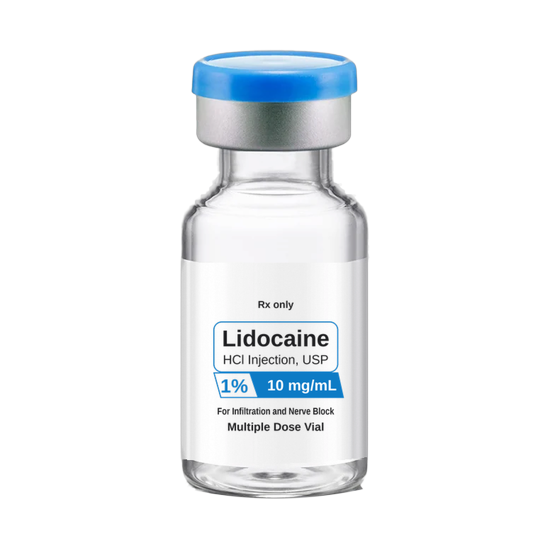
Four formulations — plain and with Epinephrine 1:100,000 — in single-dose and MDV formats for IV therapy, vein care, and aesthetic procedures.
Lidocaine HCl is the most widely used local anesthetic in medical practice — and one of the most frequently shortage-affected injectable drugs in the U.S. market. Legere maintains consistent supply across four formulations, giving IV therapy clinics, vein care providers, aesthetic medicine practices, and independent medical providers reliable access when commercial supply is constrained.
| SKU | Concentration | Epinephrine | Format | Best For |
|---|---|---|---|---|
| Lidocaine 2% | 20 mg/mL | None | Single-dose | Nerve block, deep infiltration, procedures requiring greater anesthetic depth |
| Lidocaine 1% MDV | 10 mg/mL | None | Multi-dose vial | IV line comfort, high-volume IV therapy, superficial infiltration |
| Lidocaine/Epi 2% 1:100,000 | 20 mg/mL + 10 mcg/mL Epi | Yes | Single-dose | Extended anesthesia, reduced bleeding, longer procedures |
| Lidocaine/Epi 1% MDV | 10 mg/mL + Epinephrine | Yes | Multi-dose vial | High-volume procedures requiring vasoconstriction benefit |
Lidocaine 1% (10mg/mL): The standard concentration for IV line placement, superficial infiltration, and procedures where lower anesthetic depth is sufficient. The lower concentration reduces systemic accumulation risk in high-volume applications — relevant for IV therapy clinics administering multiple IV insertions daily.
Lidocaine 2% (20mg/mL): Faster onset, greater anesthetic depth, and longer duration. Used for deeper infiltration, peripheral nerve block, and procedures requiring more complete regional anesthesia. Standard for vein care, dermatologic procedures, and minor surgical applications.
Plain Lidocaine: Anesthesia alone, approximately 1–2 hours duration depending on site vascularity and concentration. Used when vasoconstriction is contraindicated or not needed.
Lidocaine with Epinephrine 1:100,000: Epinephrine causes local vasoconstriction at the injection site — slowing lidocaine absorption into systemic circulation, extending anesthetic duration by 50% or more, and reducing procedural bleeding. Preferred for longer procedures and when hemostasis improves outcomes.
Critical contraindication — end-artery areas: Epinephrine-containing formulations are absolutely contraindicated in areas supplied by end arteries: fingers, toes, nose, ears, and penis. Vasoconstriction in these areas can cause ischemia and necrosis. Use plain Lidocaine for all end-artery applications.
Single-dose: No preservative. Use entire contents and discard. Required for epidural and spinal anesthesia. Highest sterility assurance.
Multi-dose vial (MDV): Contains methylparaben preservative, allowing multiple draws within appropriate use windows. Lower per-procedure cost in high-volume settings. Do not use for epidural or spinal anesthesia.
Lidocaine HCl is acidic at its natural pH. Injection of unbuffered lidocaine causes a stinging sensation that is the primary patient complaint in IV therapy and vein care settings. Buffering raises the pH toward physiologic range, significantly reducing injection pain and accelerating onset.
Preparation: Mix plain Lidocaine HCl with Sodium Bicarbonate 8.4% at a 9:1 ratio (9 parts lidocaine to 1 part bicarb) immediately before use. Do not pre-mix and store.
Clinical benefit: Multiple studies confirm patient-reported reduction in injection pain with buffered vs. unbuffered lidocaine. In high-volume IV therapy practices where patient experience is a differentiator, buffered lidocaine is standard of care.
Important: Only plain Lidocaine formulations should be buffered. Do not buffer Lidocaine/Epinephrine formulations — sodium bicarbonate can precipitate the epinephrine component.
Lidocaine is an amide-type local anesthetic that stabilizes neuronal membranes by blocking voltage-gated sodium channels — preventing the ionic fluxes required for nerve impulse initiation and conduction. The result is reversible loss of sensation in the targeted area without effect on consciousness.
Onset: 1–5 minutes for infiltration. Faster with higher concentration and buffering.
Duration: 1–2 hours plain. Extended significantly with epinephrine.
Metabolism: Rapidly metabolized by the liver. Elimination half-life approximately 1.5–2 hours. Significantly prolonged in hepatic impairment — use with caution and reduce dose accordingly.
IV therapy clinics: Pre-insertion intradermal lidocaine wheal before IV catheter placement. The 1% MDV is the standard format for high-volume IV therapy settings — multiple draws per day, lower concentration, lower per-procedure cost. Buffered 9:1 with Sodium Bicarbonate for patient comfort.
Vein care and sclerotherapy practices: Local infiltration anesthesia for spider vein and varicose vein treatment. 1% for superficial vein care; 2% for deeper infiltration in more extensive procedures. Epinephrine formulations reduce bleeding and extend anesthetic duration for longer vein sessions.
Med spas and aesthetic medicine: Infiltration anesthesia for minor aesthetic procedures, biopsies, excisions, and injection-adjacent local anesthesia.
Dermatology and primary care: General local anesthesia for minor in-office procedures — the practice types most frequently affected by lidocaine supply constraints due to lower purchasing priority relative to hospital systems.
Sodium Bicarbonate 8.4% Injection — The buffering agent for pre-procedure lidocaine preparation. Mixed 9:1 with plain Lidocaine HCl immediately before use. Standard in IV therapy and vein care settings.
Glycerin 72% Injection — Sclerosant for vein care practices. Lidocaine anesthetizes the injection site; Glycerin 72% is administered as the sclerosant in sequence for spider vein treatment.
Polidocanol Injection — Lidocaine pre-treatment reduces procedural discomfort and improves patient tolerance of Polidocanol sclerotherapy sessions.
End-artery contraindication (epinephrine formulations): Never use Lidocaine with Epinephrine in areas supplied by end arteries — fingers, toes, nose, ears, penis. Risk of ischemia and necrosis.
Methemoglobinemia: Associated with local anesthetic use. Higher risk in G6PD deficiency, congenital methemoglobinemia, and concurrent oxidizing agent exposure. Monitor for cyanosis, rapid heart rate, or shortness of breath. Treat with methylene blue if clinically significant.
Systemic toxicity signs: Early CNS — lightheadedness, tinnitus, perioral numbness, restlessness. Cardiovascular — bradycardia, hypotension, arrhythmia. Maintain resuscitative equipment and oxygen at point of administration.
Maximum dose — plain: 4.5 mg/kg, not to exceed 300mg total.
Maximum dose — with epinephrine: 7 mg/kg, not to exceed 500mg total.
Hepatic impairment: Reduce dose — elimination half-life may be prolonged 2x or more.
Drug interactions (epinephrine formulations): MAO inhibitors and tricyclic antidepressants may produce severe prolonged hypertension. Monitor closely or avoid concurrent use.
This is a compounded medication. Compounded drugs are not FDA-approved and have not been evaluated by the FDA for safety, efficacy, or quality. This product is available by prescription only and is intended for use by or on the order of a licensed healthcare provider.
What is the difference between Lidocaine 1% and 2%?
Lidocaine 1% (10mg/mL) is used for IV line comfort, superficial infiltration, and high-volume applications where lower anesthetic depth is sufficient. Lidocaine 2% (20mg/mL) provides faster onset, greater depth, and longer duration for nerve block, deeper infiltration, and procedures requiring more complete regional anesthesia.
Why is lidocaine sometimes difficult to source from standard distributors?
Lidocaine HCl injectable has appeared on the FDA drug shortage list repeatedly since 2017, driven by manufacturing delays at major commercial producers. Independent practices — IV therapy, dermatology, primary care, aesthetics — are typically hit hardest during shortage periods, with large hospital systems having priority access to constrained supply. Legere maintains consistent lidocaine inventory across all four formulations specifically to serve independent practice needs.
When should plain Lidocaine be used instead of Lidocaine with Epinephrine?
Always use plain Lidocaine in end-artery areas (fingers, toes, nose, ears, penis). Also use plain in patients on MAO inhibitors or tricyclic antidepressants where epinephrine interaction risk applies, and in patients with peripheral vascular disease.
How is buffered lidocaine prepared?
Mix plain Lidocaine HCl with Sodium Bicarbonate 8.4% at a 9:1 ratio immediately before use. Buffering reduces injection pain and accelerates onset. Do not buffer epinephrine-containing formulations.
Is a prescription required?
Yes. All Lidocaine HCl injectable formulations are Rx only, available exclusively to licensed healthcare providers and medical practices.
This is a compounded medication. Compounded drugs are not FDA-approved and have not been evaluated by the FDA for safety, efficacy, or quality. This product is available by prescription only and is intended for use by or on the order of a licensed healthcare provider.

Schedule a no obligation/no-pressure call to quickly increase your weight loss clinic’s revenue.