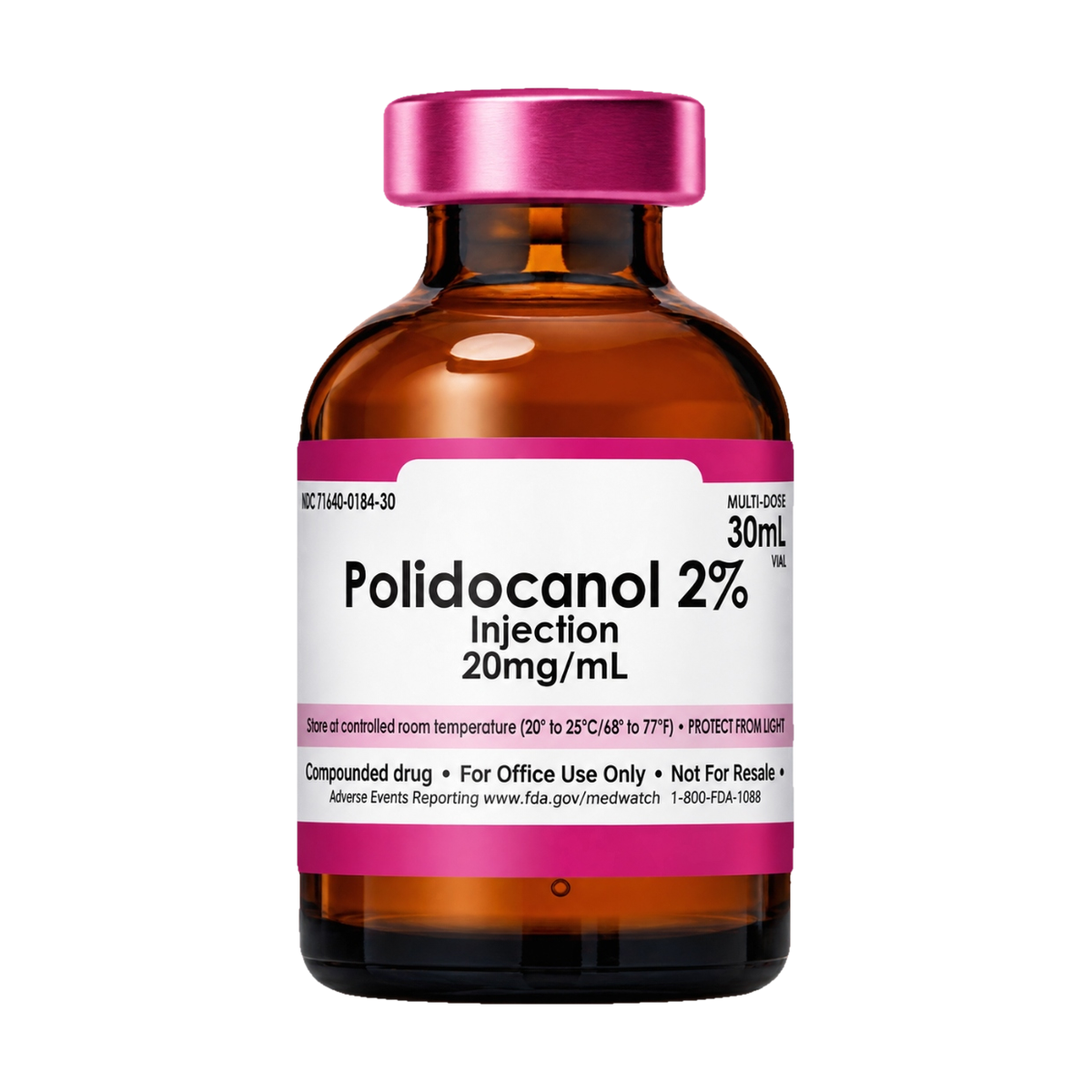
Sclerosant for licensed vein care and aesthetic practices. Treats spider and reticular veins with a well-tolerated, low-pain formula with built-in local anesthetic properties. 30mL vial.
Polidocanol 2% (20mg/mL) is a sclerosing agent used by vein care and aesthetic practices to treat spider veins and reticular veins through sclerotherapy. It damages the targeted vein’s inner lining, causing the vessel to collapse and be gradually absorbed by the body over several weeks. Polidocanol is one of the most widely used sclerosants because of its excellent tolerability and built-in local anesthetic properties which reduce discomfort at the injection site compared to older sclerosants like sodium tetradecyl sulfate (STS).
| Specification | Detail |
|---|---|
| Active ingredient | Polidocanol |
| Concentration | 2% (20 mg/mL) |
| Vial size | 30 mL |
| Route | Intralesional / intravenous (sclerotherapy) |
| Storage | Room temperature, protected from light |
Legere supplies licensed medical practices with a range of quantities to fit your volume needs. To get pricing, check availability, or place an order, click Request a Quote above or contact our team directly. A valid medical or pharmacy license is required to purchase prescription and injectable products.
Polidocanol is a non-ionic detergent sclerosant. When injected directly into a target vein, it disrupts the phospholipid layer of the vein’s endothelial cells — the cells lining the inner wall. This damage causes the vein to become inflamed, contract, and eventually collapse. Over the following weeks, the body absorbs the collapsed vessel, and the previously visible vein fades from view.
The local anesthetic property is a practical clinical advantage: polidocanol has an inherent mild numbing effect at the injection site, reducing the stinging sensation that patients often associate with sclerotherapy. This contributes to the better patient experience and tolerability profile that makes polidocanol a preferred choice over more irritating sclerosants for many vein care practitioners.
Spider veins (telangiectasias) are the small, visible surface vessels typically measuring 0.1–1mm in diameter — the fine red or purple web-like veins commonly appearing on the legs, face, and ankles. Polidocanol 2% is appropriate for the mid-to-larger end of this range.
Reticular veins are slightly larger feeding vessels, typically 1–3mm in diameter, that are often visible as bluish veins just below the skin surface. Polidocanol 2% is well-suited for reticular vein treatment.
For the smallest spider veins (0.2–0.4mm), Glycerin 72% — also available from Legere — may be preferred as a gentler sclerosant at that diameter range where Polidocanol can be too aggressive.
| Polidocanol 2% | Glycerin 72% | |
|---|---|---|
| Best for | Reticular veins and mid-large spider veins (0.5–3mm) | Smallest spider veins (0.2–0.4mm) |
| Local anesthetic | Yes — built-in mild numbing | No |
| Tolerability | Excellent | Very good, low side effect profile |
| Mechanism | Non-ionic detergent | Osmotic sclerosant |
Practices running comprehensive sclerotherapy programs typically stock both — Glycerin for the smallest vessels and Polidocanol for reticular veins and larger spider veins.
Vein care and phlebology practices: Polidocanol is a standard-of-care sclerosant for spider and reticular vein treatment. At 2% concentration in a 30mL vial, it provides sufficient volume for multiple patient treatments per vial.
Aesthetic and dermatology-adjacent practices: Spider vein removal is a high-demand cosmetic service. Practices offering medical aesthetics use Polidocanol as their primary sclerosant for leg and facial spider veins.
Medical spas with vein care services: For practices offering cosmetic vein treatment alongside aesthetic services, Polidocanol is the practical go-to sclerosant.
Glycerin Injection 72% — Glycerin for the smallest spider veins (0.2–0.4mm); Polidocanol for reticular veins and larger spider veins. Practices with a full sclerotherapy menu stock both.
Zensa Numbing Cream — Topical numbing before sclerotherapy procedures for practices that want additional pre-treatment comfort management.
Lidocaine HCl Injection — For practices also offering vein care alongside local anesthetic injection procedures.
Contraindications: Do not use in patients with known hypersensitivity to Polidocanol or its components; acute deep vein thrombosis or thromboembolic disease; acute superficial thrombophlebitis; severe peripheral arterial disease; infection or cellulitis at the injection site; or pregnancy.
Accidental intra-arterial injection: Sclerosants must be injected into the target vein only. Inadvertent intra-arterial injection can cause serious tissue damage. Only trained providers should perform sclerotherapy.
Foam sclerotherapy: Polidocanol can be prepared as foam (mixed with air using the Tessari method) for enhanced contact with the vein wall. Practices using foam sclerotherapy should follow established technique protocols.
Post-procedure care: Compression stockings are typically recommended after sclerotherapy to promote vein collapse and reduce bruising. Patients should avoid high-impact activity for 24–48 hours post-treatment.
Prescription required. A valid medical or pharmacy license is required to purchase.
How do I order, and what quantities are available?
Contact our team directly to place an order or request a quote. Polidocanol 2% is available in 30mL vials. Reach out for current pricing, lead times, and volume options. A valid medical or pharmacy license is required.
How many treatments does a 30mL vial support?
Each treatment session typically uses 0.5–1mL per treatment site depending on vessel size, number of vessels treated, and injection technique. A 30mL vial provides enough volume for multiple patient sessions — exact yield depends on your protocol and patient volume.
Is Polidocanol appropriate for facial spider veins as well as leg veins?
Yes. Polidocanol is used for spider veins in both locations. Facial spider veins typically require lower volumes and more precise technique given the vascular anatomy — providers should be trained in facial sclerotherapy before treating these areas.
What is the difference between Polidocanol and Glycerin 72%?
Polidocanol works as a detergent sclerosant — disrupting the cell membrane of the vein lining. Glycerin works osmotically — dehydrating the vein cells. Glycerin is preferred for the smallest spider veins (0.2–0.4mm); Polidocanol handles the reticular veins and larger spider veins more effectively. Many vein care practices stock both.
This is a prescription injectable product. A valid medical or pharmacy license is required to purchase. For use by licensed healthcare providers only.

Schedule a no obligation/no-pressure call to quickly increase your weight loss clinic’s revenue.