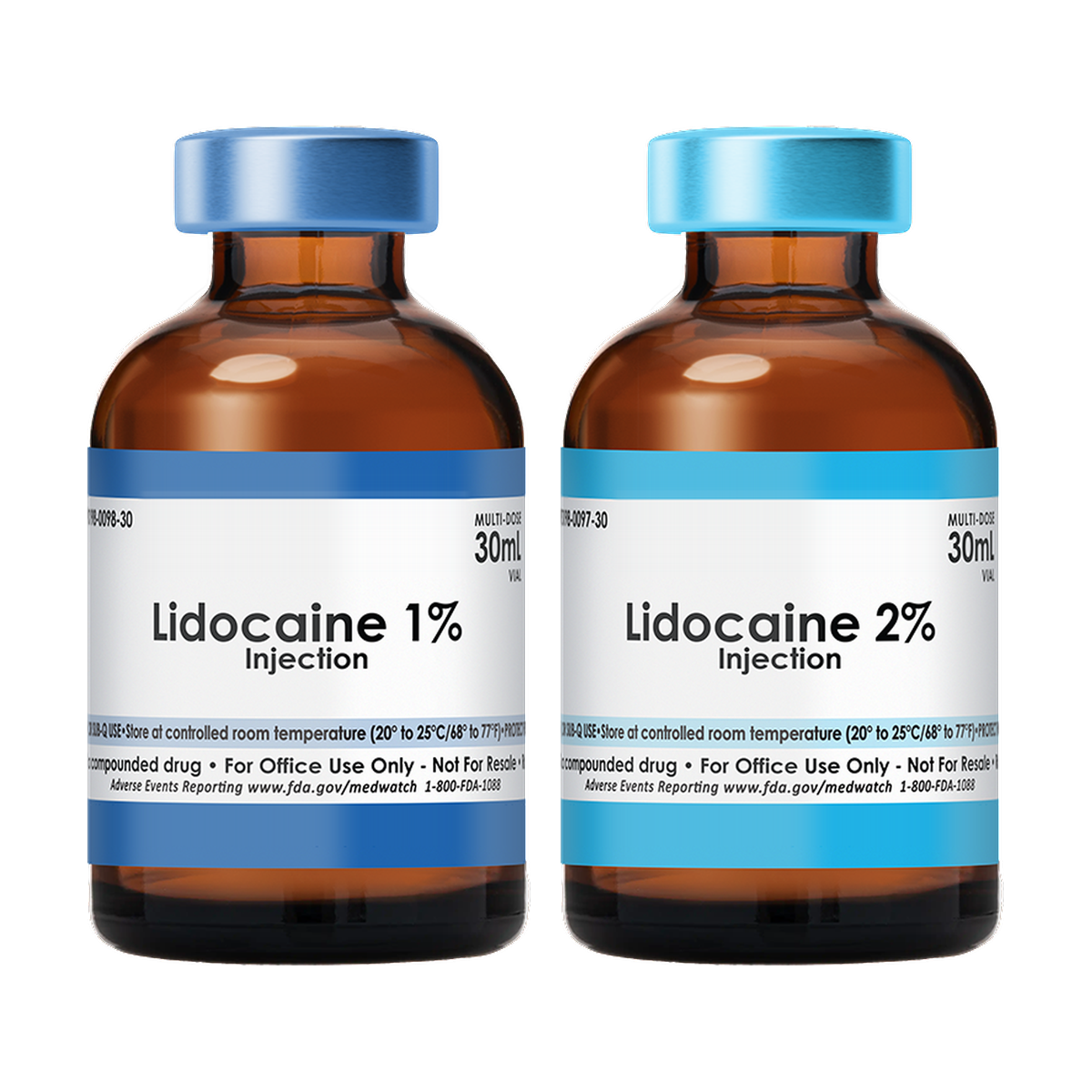
Lidocaine HCl is available in 1% (10mg/mL) and 2% (20mg/mL) for fast-acting, localized procedural anesthesia in vein care, dermatology, and minor surgery. Available as a compounded alternative during commercial drug shortage.
Lidocaine hydrochloride is the most widely used local anesthetic in clinical practice. It blocks voltage-gated sodium channels in nerve membranes, preventing pain signal transmission in the targeted area without affecting patient alertness or orientation. Available in two concentrations to match the procedural need — 1% for standard vein care and dermatological applications, 2% for larger areas or longer procedures.
Both concentrations are also available as compounded alternatives during periods of commercial drug shortage, when commercially manufactured Lidocaine 1% and 2% have had recurring supply disruptions.
| Specification | 1% | 2% |
|---|---|---|
| Active ingredient | Lidocaine HCl | Lidocaine HCl |
| Concentration | 1% (10 mg/mL) | 2% (20 mg/mL) |
| Route | IM, IV, or SQ | IM, IV, or SQ |
| Storage | Room temperature; protect from light | Room temperature; protect from light |
Choose 1% (10mg/mL) for most vein care, dermatological, and superficial procedures — the standard concentration for office-based procedural settings. Most commonly used in sclerotherapy, skin biopsies, and minor aesthetic interventions.
Choose 2% (20mg/mL) when higher concentration is needed for larger treatment areas, deeper tissue infiltration, or procedures requiring a longer anesthetic window. Also the standard concentration for dental-adjacent procedures.
Rapid onset: Local anesthesia typically within 1–2 minutes of injection — practical for office-based procedures with efficient patient throughput.
Localized effect: Patients remain fully alert and oriented. Effect is confined to the targeted tissue only.
Sclerotherapy buffering: When mixed with Sodium Bicarbonate 8.4% at a 9:1 ratio, Lidocaine’s pH is raised toward physiological levels — significantly reducing the injection burning sensation during sclerotherapy and improving patient tolerability.
Drug shortage coverage: Both concentrations have experienced commercial supply disruptions. Compounded Lidocaine provides consistent access when commercially manufactured product is limited or unavailable.
Sodium Bicarbonate 8.4% Injection — The standard buffering partner. Mix at 9:1 (9 parts Lidocaine to 1 part Sodium Bicarbonate) to significantly reduce injection burning and improve patient comfort during sclerotherapy.
Polidocanol 2% Injection — Lidocaine provides local anesthesia at treatment sites before or during Polidocanol sclerotherapy for larger or more sensitive treatment areas.
Glycerin 72% Injection — For fine spider vein treatment where additional patient comfort support at the injection site is desired alongside the sclerosant.
Contraindications:
Medical history requiring provider review:
Signs of Lidocaine toxicity — seek immediate attention:
Monitor patients during and after administration. Lidocaine toxicity is dose-related — do not exceed recommended doses for the procedure type and patient weight.
Pregnancy and breastfeeding: consult clinical specialists before use.
As a compounded Rx product, Lidocaine HCl Injection has not been evaluated by the FDA for safety, efficacy, or quality. Administer only under the supervision of a licensed healthcare provider.
FAQs
Is a prescription required to order Lidocaine HCl Injection?
Yes. Available exclusively to licensed healthcare providers and medical practices.
What concentrations are available?
1% (10mg/mL) for standard vein care and dermatological procedures, and 2% (20mg/mL) for larger areas or longer procedures requiring a higher concentration.
Why is compounded Lidocaine available?
Both concentrations have experienced commercial drug shortages. Compounded Lidocaine provides consistent access when commercially manufactured product is unavailable or in limited supply.
What is the standard buffering ratio with Sodium Bicarbonate?
9 parts Lidocaine to 1 part Sodium Bicarbonate 8.4%. This raises pH toward physiological levels, significantly reducing injection burning and improving patient comfort during procedures.
This is a compounded medication. Compounded drugs are not FDA-approved and have not been evaluated by the FDA for safety, efficacy, or quality. This product is available by prescription only and is intended for use by or on the order of a licensed healthcare provider.

Schedule a no obligation/no-pressure call to quickly increase your weight loss clinic’s revenue.