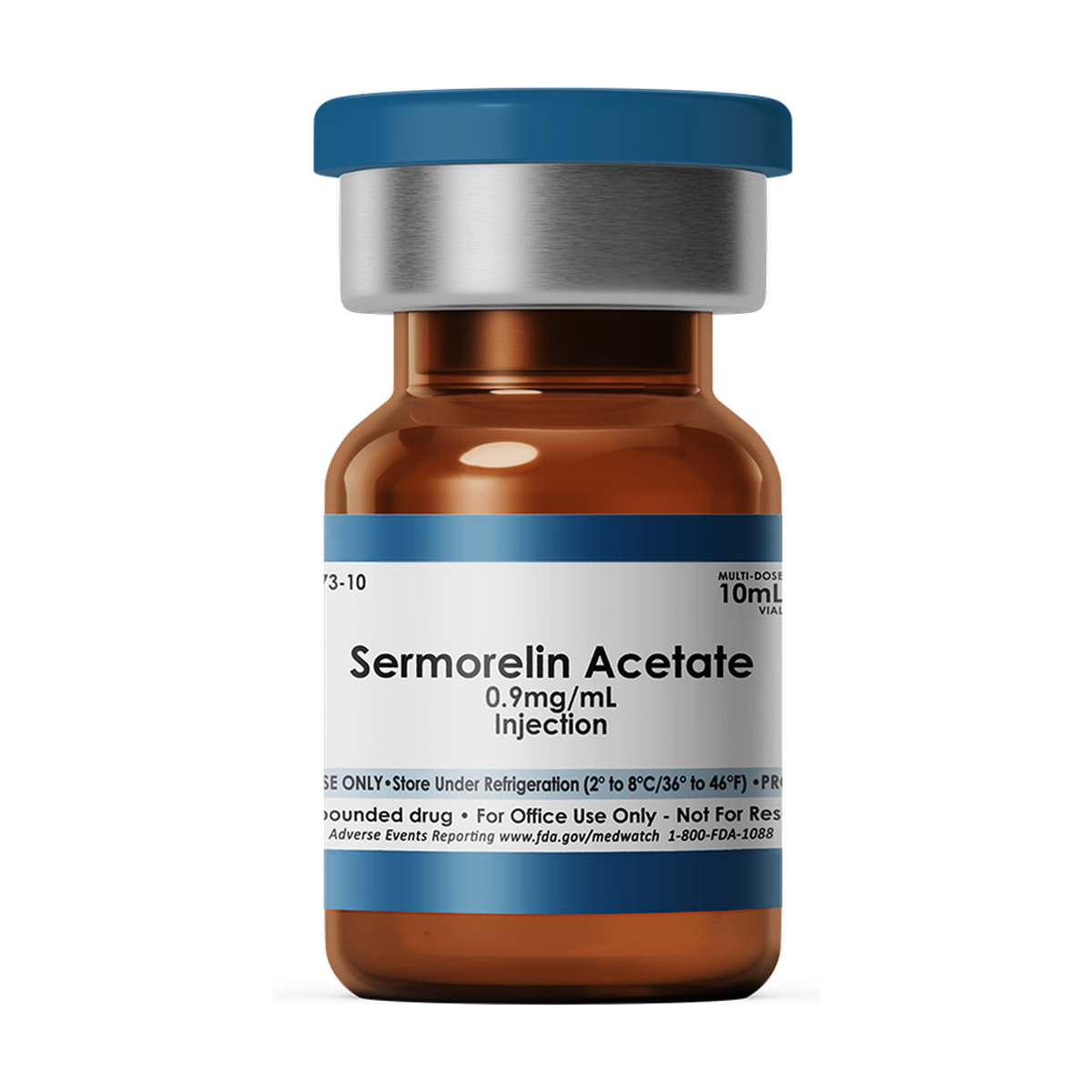
Sermorelin Acetate at 0.9mg/mL is a synthetic GHRH peptide that stimulates the pituitary gland to increase natural growth hormone production. A cornerstone peptide for anti-aging, hormone optimization, and body composition protocols in licensed practices.
Sermorelin Acetate is a compounded peptide analogue of growth hormone-releasing hormone (GHRH) — the naturally occurring peptide produced by the hypothalamus that signals the pituitary gland to release growth hormone (GH). Unlike direct growth hormone replacement, Sermorelin works upstream in the hormonal cascade, stimulating the pituitary’s own GH production rather than bypassing it. This indirect mechanism preserves the pituitary’s natural regulatory feedback, producing a more physiological GH release pattern than exogenous HGH administration.
Sermorelin is one of the most established peptides in the anti-aging and hormone optimization category, with a well-understood mechanism and a clinical profile that suits practices building evidence-based peptide protocols.
| Specification | Detail |
|---|---|
| Active ingredient | Sermorelin Acetate (GHRH peptide) |
| Concentration | 0.9 mg/mL |
| Route | IM or SQ |
| Storage | Refrigerate; protect from light |
| Sermorelin Peptide | Exogenous HGH | |
|---|---|---|
| Mechanism | Stimulates pituitary to release its own GH | Delivers GH directly |
| Feedback loop | Preserved — natural regulation intact | Bypassed |
| GH release pattern | Pulsatile (physiological) | Continuous (non-physiological) |
| Pituitary function | Maintained and stimulated | Suppressed over time |
| Regulatory status | Compounded peptide | Prescription drug |
For practices building peptide-based anti-aging and hormone optimization protocols, Sermorelin offers the advantage of working with the body’s own regulatory system rather than replacing it.
Growth hormone stimulation: Sermorelin binds to GHRH receptors on pituitary somatotroph cells, directly stimulating the synthesis and release of growth hormone. GH levels decline significantly with age — this peptide supports the restoration of more youthful GH output without suppressing pituitary function.
Physiological release pattern: Because Sermorelin stimulates the pituitary rather than delivering GH directly, the body releases GH in its natural pulsatile pattern — typically during sleep and exercise — rather than in a continuous non-physiological manner. This is one of the key clinical advantages of GHRH-based peptide therapy over direct HGH.
Preservation of pituitary function: Long-term exogenous HGH suppresses the pituitary’s own GH production through negative feedback. Sermorelin does the opposite — it actively stimulates pituitary GHRH receptors, maintaining and supporting pituitary function over time. A meaningful advantage for practices focused on long-term hormonal health rather than short-term supplementation.
Body composition support: GH plays a direct role in lipolysis (fat breakdown), lean muscle maintenance, and tissue repair. Supporting GH production with this peptide contributes to the body composition benefits associated with healthy GH levels.
Sleep and recovery: GH is predominantly released during deep sleep. Sermorelin is commonly administered before bed to support the nocturnal GH pulse, contributing to improved sleep quality and overnight tissue repair and recovery — outcomes patients on peptide protocols frequently report.
Gonadorelin Injection — For practices building comprehensive hormone optimization protocols. Gonadorelin supports the HPG axis (LH, FSH, testosterone) while Sermorelin supports the GH axis — two complementary peptide protocols that together address the primary hormonal pathways that decline with age.
L-Carnitine Injection — Adds fat transport support alongside Sermorelin’s GH-mediated lipolysis for patients pursuing body composition improvements as part of their peptide protocol.
NAD+ Injection — Supports cellular energy and mitochondrial function alongside Sermorelin’s anabolic and tissue repair effects, a natural pairing for comprehensive anti-aging and longevity peptide programs.
Conditions requiring provider evaluation before initiating:
Common side effects: Pain, redness, swelling, or bruising at the injection site. Flushing, headache, or dizziness may occur transiently after injection.
Drug interactions: Glucocorticoids may blunt GH response to GHRH peptide stimulation. Full medication review recommended before initiating.
Pregnancy and breastfeeding: Not recommended; consult clinical specialists.
As a compounded Rx product, Sermorelin Acetate Injection has not been evaluated by the FDA for safety, efficacy, or quality. Administer only under the supervision of a licensed healthcare provider.
Is a prescription required to order Sermorelin Peptide Injection?
Yes. Available exclusively to licensed healthcare providers and medical practices.
What is the concentration and route?
0.9mg/mL, for IM or SQ administration. Refrigerate and protect from light.
How does Sermorelin peptide differ from direct growth hormone therapy?
Sermorelin is a GHRH peptide that stimulates the pituitary gland to produce its own growth hormone, preserving the natural feedback loop and pulsatile GH release pattern. Direct HGH administration bypasses the pituitary entirely and suppresses its function over time. Sermorelin peptide therapy works with the body’s regulatory system rather than replacing it.
Why is hypothyroidism a consideration before starting Sermorelin?
Thyroid hormones are required for a normal pituitary GH response to GHRH peptide stimulation. Patients with untreated hypothyroidism may have a blunted response. Thyroid status should be evaluated and optimized before initiating.
This is a compounded medication. Compounded drugs are not FDA-approved and have not been evaluated by the FDA for safety, efficacy, or quality. This product is available by prescription only and is intended for use by or on the order of a licensed healthcare provider.

Schedule a no obligation/no-pressure call to quickly increase your weight loss clinic’s revenue.