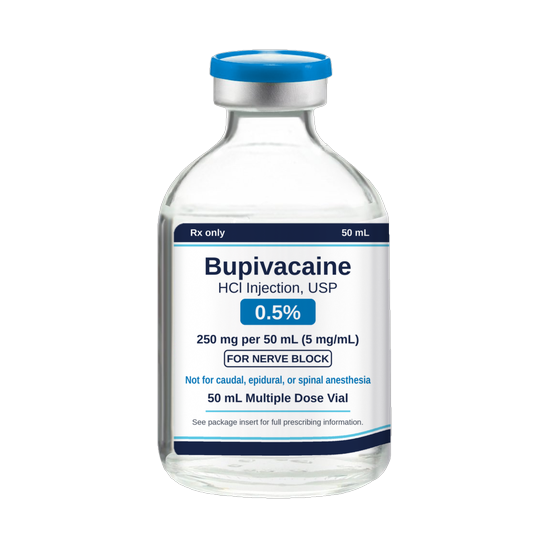
Bupivacaine injection 0.25% and 0.5% — generic Marcaine — for licensed medical practices. Long-acting local anesthetic providing 4-12 hours of numbing for procedures, nerve blocks, and post-procedure pain management.
Bupivacaine — generic Marcaine — is a long-acting local anesthetic that numbs a targeted area for 4-12 hours, significantly longer than lidocaine’s 1-2 hour window. That extended duration makes it the preferred numbing agent for procedures where post-procedure pain control matters as much as intraoperative comfort. Available in 0.25% and 0.5% concentrations. The 0.75% concentration is not stocked. Rx only.
| Concentration | Strength | Primary Clinical Use | Vial Format |
|---|---|---|---|
| 0.25% | 2.5 mg/mL | Infiltration; minor nerve blocks; low-motor-block applications | SDV / MDV |
| 0.5% | 5 mg/mL | Standard concentration; peripheral nerve blocks; epidural; procedural anesthesia | SDV / MDV |
| 0.75% | 7.5 mg/mL | Major surgical blocks; deeper anesthesia; retrobulbar eye blocks | SDV only |
Legere supplies licensed medical practices with a range of quantities to fit your volume needs. To get pricing, check availability, or place an order, click Request a Quote above or contact our team directly. A valid medical or pharmacy license is required to purchase prescription and injectable products.
Bupivacaine blocks sodium channels in nerve fibers, preventing pain signals from reaching the brain. The effect is localized to the injected area — sensation is blocked while the patient stays fully awake and alert.
What sets bupivacaine apart from lidocaine is how long it lasts. Lidocaine’s numbing effect fades in 1-2 hours. Bupivacaine continues working for 4-12 hours depending on concentration, injection site, and whether epinephrine is added. For procedures where patients will feel pain after the anesthetic wears off — joint injections, minor surgical procedures, nerve blocks — bupivacaine’s extended coverage is clinically meaningful.
Both are local anesthetics in Legere’s formulary. The right choice depends on how long coverage is needed.
| Bupivacaine (Generic Marcaine) | Lidocaine HCl | |
|---|---|---|
| Onset | Slower (10-20 min) | Faster (5-10 min) |
| Duration | 4-12 hours | 1-2 hours |
| Best for | Post-procedure pain coverage; longer procedures; nerve blocks | Short procedures; quick onset needed; IV line prep; vein care |
| Concentrations | 0.25% and 0.5% | 1% and 2% |
Many practices stock both — lidocaine for short-duration procedures and quick-onset needs, bupivacaine where post-procedure pain management over several hours is the goal.
Pain management and interventional practices: Bupivacaine is a standard component of joint injection protocols. When a patient is receiving an intra-articular steroid injection for knee, shoulder, or hip pain, bupivacaine provides immediate local pain relief while the steroid takes effect over the following days.
Aesthetic and surgical practices: Longer aesthetic procedures benefit from bupivacaine’s extended numbing window. Post-procedure comfort for several hours reduces the patient’s pain burden during early recovery and lowers the need for systemic pain medications at discharge.
Vein care practices: Local anesthetic for post-procedure pain management following sclerotherapy or other vein interventions where comfort during and after treatment affects patient experience.
Urgent care and minor procedure practices: Laceration repair, incision and drainage, and other minor procedures where post-procedure pain coverage is beneficial after the patient leaves the clinic.
Lidocaine HCl Injection — Lidocaine and bupivacaine are frequently used together in clinical practice. Lidocaine’s faster onset (3-5 minutes) addresses the onset gap of bupivacaine (5-10 minutes), while bupivacaine’s extended duration maintains the block long after lidocaine would have worn off. The combination leverages the strengths of both agents.
Sodium Bicarbonate 8.4% Injection — Buffering bupivacaine with sodium bicarbonate in a 9:1 ratio raises the pH of the solution, increasing the proportion of un-ionized drug available to cross nerve membranes. This accelerates onset and may reduce the stinging sensation associated with injection.
0.9% Sodium Chloride IV Bag — Normal saline is used for dilution and as the IV carrier when bupivacaine is incorporated into IV therapy or procedural protocols alongside hydration support.
Methylprednisolone Acetate Injection (Generic Depo-Medrol) — Bupivacaine and methylprednisolone acetate are the standard joint injection combination. Bupivacaine provides immediate local pain relief; methylprednisolone manages inflammation over the days and weeks following the injection.
Not for IV use: Bupivacaine is for local infiltration, nerve blocks, and epidural use only. Intravenous injection is a serious medication error that can cause life-threatening cardiovascular toxicity.
Local anesthetic systemic toxicity (LAST): If bupivacaine accidentally enters the bloodstream or is absorbed too rapidly, it can cause serious cardiovascular and neurological toxicity. Early signs include ringing in the ears, metallic taste, dizziness, and confusion. Severe LAST progresses to seizures and cardiac arrest. Practices administering bupivacaine must have lipid emulsion (Intralipid 20%) immediately available as the treatment, and staff must be trained to recognize and respond to LAST.
0.75% concentration not stocked: The 0.75% concentration carries a specific warning against use in obstetrical epidural anesthesia due to cardiac arrest risk. Legere does not stock the 0.75% strength.
Dose limits: Total bupivacaine dose should not exceed 175mg without epinephrine or 225mg with epinephrine in most clinical settings.
Cardiovascular disease: Use with caution in patients with known heart disease or rhythm abnormalities. Bupivacaine has greater cardiac toxicity potential than lidocaine at equivalent doses.
Not for IV regional anesthesia (Bier blocks): Bupivacaine is contraindicated for IV regional anesthesia due to cardiac toxicity risk upon tourniquet release.
For use by or on the order of a licensed healthcare provider.
How do I order, and what quantities are available?
Contact our team directly to place an order or request a quote. We supply a range of quantities depending on the product — reach out for current availability, lead times, and volume pricing. A valid medical license is required to purchase prescription and injectable products.
What is the difference between bupivacaine 0.25% and 0.5%?
Both work the same way. The 0.5% provides more complete numbing and is used for nerve blocks and procedures requiring full sensory and motor blockade. The 0.25% suits local infiltration and situations where lighter numbing is sufficient. Your prescribing provider’s protocol determines which concentration fits the procedure.
How does bupivacaine compare to lidocaine?
Lidocaine works faster but wears off in 1-2 hours. Bupivacaine takes longer to kick in but lasts 4-12 hours. For short procedures or situations where fast onset matters most, lidocaine is the better fit. For longer procedures or when post-procedure pain coverage is the goal, bupivacaine is the clinical choice.
Why must lipid emulsion be available when using bupivacaine?
In rare cases, bupivacaine can reach the bloodstream at levels that affect the heart and nervous system — a reaction called local anesthetic systemic toxicity (LAST). Lipid emulsion (Intralipid 20%) is the rescue treatment. Clinical guidelines require it to be immediately available whenever bupivacaine is administered. Practices using bupivacaine should have lipid emulsion stocked and staff trained to recognize LAST.
Is a prescription required?
Yes. Bupivacaine is Rx only, available exclusively to licensed healthcare providers and medical practices.
For use by or on the order of a licensed healthcare provider. Administer only in clinical settings equipped for patient monitoring and emergency resuscitation.

Schedule a no obligation/no-pressure call to quickly increase your weight loss clinic’s revenue.