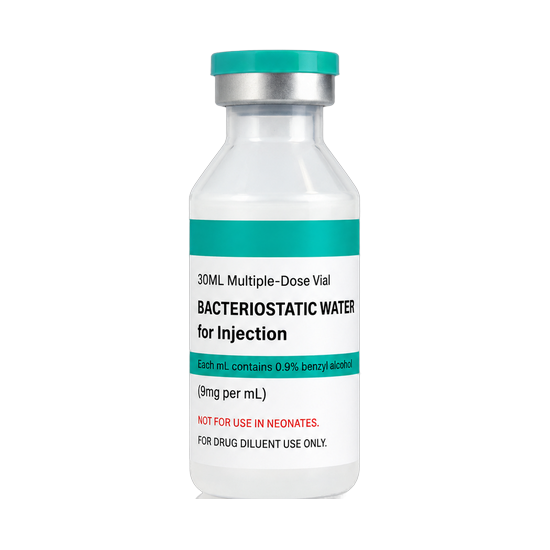
Bacteriostatic Water for Injection USP — sterile water containing 0.9% benzyl alcohol for multi-dose reconstitution of lyophilized peptides and injectable compounds. The standard diluent for Sermorelin, Gonadorelin, and other peptide protocols.
Bacteriostatic Water for Injection USP is sterile water containing 0.9% benzyl alcohol as an antimicrobial preservative. It is the standard diluent for reconstituting lyophilized (freeze-dried) peptide powders — including Sermorelin, Gonadorelin, and other injectable peptides — because the benzyl alcohol preservative inhibits bacterial growth after the vial is first punctured, allowing multiple draws from a single vial across the multi-day dosing schedules typical of peptide protocols.
It is not interchangeable with sterile water for injection, normal saline, or other diluents. The preservative is what makes it appropriate for multi-dose use.
| Specification | Detail |
|---|---|
| Active preservative | Benzyl alcohol 0.9% |
| Base | Sterile water for injection |
| Tonicity | Hypotonic (water only) |
| Preservative | Yes — multi-dose use |
| Volume | 30 mL |
| Storage | Room temperature |
Lyophilized peptides — Sermorelin, Gonadorelin, and other peptide injectables — are supplied as dry powder in vials. They must be reconstituted with a sterile diluent before injection. The choice of diluent matters for two reasons:
1. Sterility across multiple draws:
Peptide protocols typically involve daily or multiple-times-weekly injections from the same reconstituted vial over days or weeks. Each time a needle enters the vial stopper, there is a potential for bacterial contamination. The benzyl alcohol in bacteriostatic water inhibits bacterial growth between uses — protecting the integrity of the solution across the full use period of the vial. Plain sterile water for injection has no preservative and is only appropriate for single-dose use.
2. Peptide stability:
Benzyl alcohol provides a mildly acidic, stable environment that is compatible with the majority of therapeutic peptides. Using incompatible diluents — including saline in some formulations — can cause precipitation, degradation, or altered peptide stability that compromises both potency and patient safety.
The amount of bacteriostatic water added to a peptide vial determines the concentration of the resulting solution — not the total dose. This is one of the most clinically important concepts for practices initiating peptide protocols:
At lower concentration, more volume must be drawn to deliver the same dose — and the corresponding syringe unit markings change accordingly. Always reconstitute according to the specific peptide protocol’s required concentration.
| Bacteriostatic Water | Sterile Water for Injection | Normal Saline (0.9% NaCl) | |
|---|---|---|---|
| Preservative | Yes (benzyl alcohol 0.9%) | None | None |
| Use type | Multi-dose | Single-dose only | Per product compatibility |
| Peptide reconstitution | Standard | Single-dose only | Not interchangeable |
| After opening | Multiple draws supported | Discard after single use | Per labeling |
Do not substitute sterile water, saline, or any other diluent for bacteriostatic water when a peptide protocol calls for it. The preservative is clinically meaningful, not cosmetic.
Peptide reconstitution: The primary use. Sermorelin, Gonadorelin, and other lyophilized peptide injectables supplied as powder require reconstitution with bacteriostatic water before administration. The 30mL vial size provides sufficient diluent volume for multiple peptide vials across a full protocol period.
Other lyophilized injectables: Any lyophilized injectable compound intended for multi-dose use where benzyl alcohol is the appropriate preservative. Confirm diluent compatibility for each specific compound before reconstitution.
Always follow the specific reconstitution instructions provided with the peptide product. This general protocol does not supersede product-specific instructions.
Sermorelin Acetate Injection — Sermorelin is supplied as a lyophilized powder and requires reconstitution with bacteriostatic water before subcutaneous or intramuscular injection. The 30mL vial of bacteriostatic water provides sufficient diluent for an extended Sermorelin protocol.
Gonadorelin Peptide Injection — Gonadorelin is similarly supplied as lyophilized powder for reconstitution. Practices running both Sermorelin and Gonadorelin protocols will use bacteriostatic water for both.
Insulin Syringes — The standard syringe for subcutaneous peptide administration after reconstitution. U-100 insulin syringes allow precise dose measurement of reconstituted peptide solutions.
Benzyl alcohol toxicity in newborns: Benzyl alcohol has been associated with serious adverse events and death in neonates. Bacteriostatic Water for Injection is contraindicated in newborns. For pediatric use, always confirm age-appropriate diluent selection.
Single-use products only: Do not use bacteriostatic water to reconstitute single-dose vials or products labeled for single-use only. The multi-dose indication applies to the diluent — not automatically to the compound being reconstituted.
Vial integrity: Mark the first puncture date on the bacteriostatic water vial and follow its discard instructions. The reconstituted peptide solution has a separate beyond-use date — always use the earlier applicable date.
Inspect before use: Do not use if solution is cloudy, discolored, or contains visible particles.
For use by or on the order of a licensed healthcare provider.
Why can’t I use regular sterile water instead of bacteriostatic water for peptides?
Sterile Water for Injection contains no preservative — it is a single-dose product. Once the vial is punctured, there is no antimicrobial protection against bacterial contamination. Peptide protocols require multiple draws from the same reconstituted vial over days or weeks. Bacteriostatic water’s benzyl alcohol preservative inhibits bacterial growth between uses, making it the appropriate diluent for multi-dose peptide reconstitution.
How much bacteriostatic water should I add to a peptide vial?
The specific peptide protocol and required concentration determines the volume. As a general rule: the more bacteriostatic water added, the lower the concentration per mL, meaning more volume must be drawn to deliver the same dose. Always follow the reconstitution instructions provided with the specific peptide product.
How long does reconstituted peptide last once mixed with bacteriostatic water?
This varies by peptide. Most reconstituted peptides stored under refrigeration remain stable for 14–28 days. Always follow the specific beyond-use date provided with the peptide product or by the prescribing provider. Use whichever date — bacteriostatic water’s own discard date or the peptide’s beyond-use date — comes first.
Can bacteriostatic water be used for all peptides?
It is the standard diluent for most therapeutic peptides used in clinical practice including Sermorelin and Gonadorelin. Some peptides or formulations may require a specific diluent — always confirm compatibility with the product-specific reconstitution instructions before use.
This is a compounded medication. Compounded drugs are not FDA-approved and have not been evaluated by the FDA for safety, efficacy, or quality. This product is available by prescription only and is intended for use by or on the order of a licensed healthcare provider.

Schedule a no obligation/no-pressure call to quickly increase your weight loss clinic’s revenue.