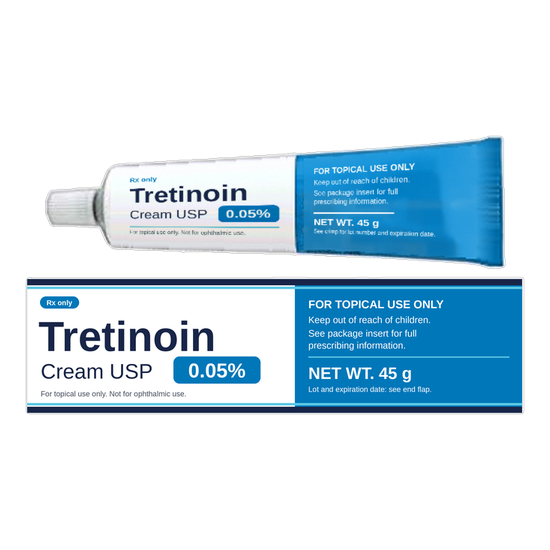
Tretinoin cream — generic Retin-A — in 0.05% and 0.1% for acne vulgaris treatment and photoaging management.
Tretinoin — the generic form of Retin-A® — is a topical retinoid and the active, bioavailable form of vitamin A (all-trans-retinoic acid). It is FDA-approved for the treatment of acne vulgaris and is the most extensively studied topical agent for photoaging in dermatology, with clinical evidence spanning more than five decades. Available in 0.05% and 0.1% concentrations, tretinoin cream is the foundational prescription retinoid for dermatology, medical aesthetics, anti-aging, and integrative skin health practices.
| Concentration | Primary Clinical Use | Best For |
|---|---|---|
| 0.05% | Acne; moderate photoaging; hyperpigmentation | Standard maintenance concentration; patients with established retinoid tolerance |
| 0.1% | Resistant acne; advanced photoaging | Experienced retinoid users; titration endpoint for maximum efficacy |
Tretinoin is a retinoic acid receptor (RAR) agonist — it binds directly to nuclear RAR receptors, bypassing the conversion step required by OTC retinol products. This direct bioavailability is what makes prescription tretinoin clinically distinct from over-the-counter retinol serums: it reaches its target in its active form without enzymatic conversion losses or the variability that conversion introduces between patients.
For acne:
Tretinoin normalizes follicular epithelial desquamation — the abnormal shedding of skin cells inside the follicle that leads to microcomedone formation. By preventing the cellular cohesion that clogs follicles, it addresses acne at its origin rather than treating existing lesions. It also has anti-inflammatory activity relevant to inflammatory acne presentations.
For photoaging:
Tretinoin stimulates epidermal thickening, collagen synthesis, and fibroblast activity in the dermis while inhibiting collagenase — the enzyme that breaks down existing collagen. This dual mechanism both builds new structural support and slows its degradation. Long-term use produces measurable improvements in fine lines, wrinkle depth, skin texture, and mottled pigmentation.
For hyperpigmentation:
Tretinoin reduces melanin production and accelerates the shedding of pigmented surface cells, improving post-inflammatory hyperpigmentation, melasma, and sunspot appearance over time.
IV therapy and wellness clinics: Ketorolac is increasingly used in IV therapy settings for acute pain relief — headache (including migraine), musculoskeletal pain, and post-exertion soreness — as a non-opioid injectable analgesic that fits naturally into the IV therapy service model. Administered as an IV push into a running normal saline line or diluted into the bag.
Hangover and recovery IV protocols: Ketorolac addresses the inflammatory and pain components of hangover alongside the hydration provided by normal saline and the energy support of B-vitamins — a practical addition to recovery IV protocols for practices serving that patient population.
Post-procedure pain management: For practices performing minor in-office procedures — aesthetic, vein care, dermatologic — ketorolac provides short-term acute pain management without opioids or controlled substance prescribing.
Urgent care and primary care: Acute musculoskeletal pain, renal colic adjunct, migraine, and other acute pain presentations where rapid injectable NSAID analgesia is the appropriate clinical response.
Sports medicine and performance practices: Acute sports-related injuries and post-training inflammatory pain in patients where opioids are inappropriate, unavailable, or undesirable.
| 0.05% | 0.1% | |
|---|---|---|
| Acne efficacy | Active — strong lesion reduction | Maximum potency; for resistant acne |
| Anti-aging evidence | Deep clinical evidence base for photoaging reversal | Maximum strength for advanced photoaging |
| Irritation profile | Moderate — appropriate for established retinoid users | Highest — requires demonstrated tolerance |
| Clinical use | Standard maintenance; step-up from initiation | Experienced users; protocol titration endpoint |
For most patients initiating tretinoin therapy, practices typically start at 0.025% (if available) or begin at 0.05% with every-other-night application before progressing to nightly use. The 0.1% concentration is appropriate for patients who have established good retinoid tolerance over 8–12 weeks at 0.05%.
Medical aesthetics and anti-aging practices: Tretinoin is the prescription anchor of any medical-grade skincare protocol. It addresses the core drivers of photoaged skin — collagen loss, surface texture, pigmentation — through a mechanism that no OTC ingredient replicates. Practices differentiating on clinical outcomes build protocols around prescription retinoids, and tretinoin at 0.05% and 0.1% covers the full range of maintenance and advanced-protocol patients.
Dermatology and acne-focused practices: First-line topical retinoid for acne vulgaris. Addresses comedonal and inflammatory acne at the follicular level, prevents new microcomedone formation, and reduces post-inflammatory hyperpigmentation — three of the four primary acne treatment goals in a single agent. Appropriate as monotherapy for mild acne and in combination with benzoyl peroxide or topical antibiotics for moderate presentations.
Hormone optimization and BHRT practices: Hormonal changes — perimenopause, post-menopause, androgen shifts — accelerate skin aging and can trigger adult-onset acne. Tretinoin addresses both simultaneously, making it a natural extension for practices already managing patients through hormonal transitions.
GLP-1 and medical weight loss practices: Rapid weight loss can accelerate visible skin aging. Tretinoin supports collagen maintenance and skin texture as patients undergo significant body composition changes.
Routine Skin Rescue+ Serum — Hydration and barrier support alongside tretinoin. Retinoid-induced dryness and irritation — particularly during the initiation phase — are the most common reasons patients discontinue. A complementary hydrating serum applied in the morning helps maintain barrier integrity and improve patient adherence to the tretinoin protocol.
Zensa Numbing Cream — For practices performing aesthetic procedures alongside their skincare protocol. Numbing cream pairs naturally with tretinoin as part of a broader aesthetic service menu.
DHEA Capsules — For BHRT and hormone optimization practices: DHEA supports adrenal hormone precursors that influence skin health, oil production, and hormonal acne. A complementary approach for patients using tretinoin for hormonally driven acne or accelerated skin aging.
Retinoid dermatitis — initiation phase: The majority of new tretinoin users experience a retinization period of 2–6 weeks characterized by dryness, peeling, redness, and increased sensitivity. This is an expected physiologic response. Starting at 0.05% with every-other-night application before progressing to nightly use significantly reduces the severity of the initiation phase and improves patient retention on the protocol.
Sun sensitivity: Tretinoin increases photosensitivity. Instruct patients to apply only at night and use broad-spectrum SPF 30+ sunscreen every morning throughout treatment.
“Purging” with acne patients: Tretinoin accelerates the turnover of existing microcomedones to the surface before they mature into visible lesions — producing a temporary increase in breakouts during the first 4–8 weeks. Counsel acne patients on this expected initial response to prevent early discontinuation.
Pregnancy: Tretinoin is contraindicated in pregnancy. While topical absorption is lower than systemic retinoids, tretinoin cream is not recommended during pregnancy or in patients planning to conceive. Contraception counseling is appropriate for patients of childbearing age.
Eczema, rosacea, and compromised skin barrier: Use with caution in patients with active eczema, rosacea, or significant skin barrier impairment. Tretinoin can exacerbate these conditions during the initiation phase.
For use by or on the order of a licensed healthcare provider.
What is the difference between tretinoin and over-the-counter retinol?
Tretinoin is already in its active form (all-trans-retinoic acid) and binds directly to nuclear retinoic acid receptors. OTC retinol must first be converted by the skin into retinaldehyde and then into retinoic acid before it becomes active — a process that is inefficient and variable between patients. Prescription tretinoin delivers significantly more predictable, measurable clinical results than OTC retinol at any comparable concentration.
Which concentration — 0.05% or 0.1% — is appropriate for a new patient?
Most patients new to tretinoin begin at 0.05% applied every other night, progressing to nightly use as tolerance develops over 4–8 weeks. The 0.1% concentration is reserved for patients who have demonstrated good retinoid tolerance or for resistant acne cases where maximum potency is indicated. Starting at 0.1% without established tolerance is the most common cause of early discontinuation due to irritation.
How long does tretinoin take to show results?
For acne: measurable lesion reduction typically begins within 4–12 weeks. For photoaging: meaningful improvement in fine lines, texture, and pigmentation requires 3–6 months of consistent use, with continued improvement over 12+ months. Patients should be counseled on realistic timelines at initiation to support long-term adherence.
Is a prescription required?
Yes. Tretinoin cream is Rx only, available exclusively through licensed healthcare providers and medical practices.
This is a compounded medication. Compounded drugs are not FDA-approved and have not been evaluated by the FDA for safety, efficacy, or quality. This product is available by prescription only and is intended for use by or on the order of a licensed healthcare provider.

Schedule a no obligation/no-pressure call to quickly increase your weight loss clinic’s revenue.