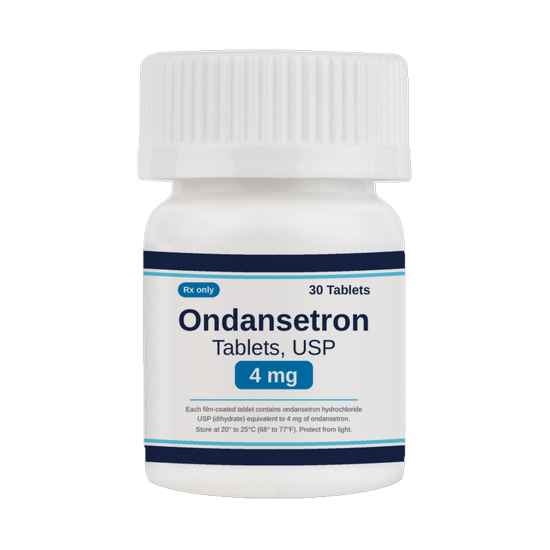
Ondansetron 4mg orally disintegrating tablets (ODT) — generic Zofran — fast-dissolving anti-nausea tablets for IV therapy recovery, GLP-1-related nausea, post-procedure dispensing, and general clinical use.
Ondansetron — generic Zofran — is the most widely used prescription anti-nausea medication in outpatient clinical practice. The 4mg orally disintegrating tablet (ODT) format dissolves on the tongue in seconds without water, making it practical for patients who are actively nauseated, for take-home dispensing at discharge, and for settings where swallowing a tablet with liquid isn’t convenient. Practices running IV therapy protocols, managing GLP-1-related nausea, or handling post-procedure recovery benefit from oral ondansetron as a complement to or alternative to injectable antiemetics in the formulary.
| Specification | Detail |
|---|---|
| Active ingredient | Ondansetron HCl |
| Strength | 4 mg |
| Dosage form | Orally disintegrating tablet (ODT) |
| Administration | Place on tongue; dissolves in seconds; swallow with saliva; no water needed |
| Storage | Room temperature or refrigerated; protect from light |
| Prescription status | Rx only |
Note: ODTs contain aspartame. Patients with phenylketonuria (PKU) should use the standard tablet or oral solution form.
Contact our team for current availability, volume pricing, and ordering details.
To get pricing, check availability, or place an order, click the Request a Quote button or contact our team directly. A valid medical or pharmacy license is required to purchase prescription and injectable products.
Ondansetron blocks 5-HT3 serotonin receptors — the specific pathway the body uses to trigger the vomiting reflex. When the GI tract is irritated by chemotherapy, anesthesia, GLP-1 medications, or other causes, it releases serotonin that activates nausea signals traveling to the brainstem. Ondansetron blocks those signals before they complete the circuit.
Unlike older anti-nausea drugs like metoclopramide or prochlorperazine, ondansetron does not affect dopamine receptors, which means it avoids the restlessness and involuntary movement side effects those drugs can cause. This is why it became the standard anti-nausea option in most outpatient settings.
The orally disintegrating tablet is the preferred format for nausea management in outpatient clinical settings for practical reasons that matter to both the practice and the patient.
Works without water. A patient who is actively nauseated often cannot or will not drink a full glass of water to swallow a tablet. The ODT eliminates that problem — place on the tongue, dissolves in seconds, done.
No IV needed. Injectable ondansetron is faster and appropriate for in-clinic use, but most outpatient nausea doesn’t require IV administration. The ODT reaches effective levels within 30-60 minutes and handles the majority of clinical scenarios without the need for IV access or setup time.
Easy to dispense at discharge. When patients leave after a procedure or IV therapy session, handing them an ODT blister pack for home use requires no special handling or instructions beyond “place on your tongue.” It’s the most practical take-home format for nausea.
Useful for GLP-1 patients on the go. GLP-1 nausea can hit at unpredictable times. An ODT in a patient’s bag or purse works anywhere, with no food or water required.
IV therapy and wellness clinics: Oral ondansetron extends anti-nausea coverage beyond the IV session. Some practices include injectable ondansetron in the IV bag and send patients home with ODTs for the following 24-48 hours. Others dispense ODTs as the primary anti-nausea tool for patients whose symptoms don’t warrant IV intervention.
GLP-1 and medical weight loss practices: Nausea is the most reported side effect of GLP-1 therapy, particularly during dose escalation. Ondansetron is the practical first-line prescription option when dietary adjustments alone aren’t enough. Practices that can dispense directly give patients immediate access to relief rather than sending them to a pharmacy mid-wave of nausea.
Aesthetic and post-procedure practices: Nausea after sedation or procedures is a common patient complaint and a driver of post-visit calls. Dispensing ondansetron ODTs at discharge reduces that call volume and improves the recovery experience — patients handle it at home instead of calling in.
Urgent care and primary care practices: Acute nausea from stomach bugs, vertigo, medication side effects, or post-anesthesia is a frequent presenting complaint. Ondansetron is the standard Rx response in outpatient settings where an IV isn’t warranted.
Oncology-adjacent and infusion practices: Primary FDA-approved use — prevention and treatment of chemotherapy-related nausea and vomiting, both during and after infusion sessions.
Both are available through Legere. They’re complementary, not interchangeable for all situations.
| Ondansetron 4mg ODT (This product) | Ondansetron Injection | |
|---|---|---|
| Route | Oral — dissolves on tongue | IV or IM |
| Onset | 30-60 minutes | 5-15 minutes (IV) |
| Best for | Take-home dispensing; GLP-1 nausea; post-discharge recovery; ongoing management | Acute in-clinic use; IV therapy add-on; immediate relief needed |
| IV access required | No | Yes (IV); No (IM) |
| Format advantage | No prep, no access required; portable | Faster onset; appropriate for severe or acute nausea or NPO patients |
IV therapy practices should stock both: injectable for in-clinic use during the session, ODTs for take-home recovery coverage.
Post-procedure nausea (PONV): 4mg at the end of a procedure or at onset of nausea. For discharge, dispense ODTs with instructions to use as needed.
General outpatient nausea: 4mg every 8 hours as needed per prescribing provider’s protocol.
GLP-1-related nausea: Dosing and frequency per provider’s clinical judgment based on severity and symptom timing.
Chemotherapy-related nausea: Standard protocol uses 8mg doses; 4mg tablets may be appropriate for lower-severity presentations or as a step-down. Confirm dose per protocol.
All dosing follows the prescribing provider’s clinical protocol and patient-specific assessment.
Dexamethasone Injection 4mg/mL — Dexamethasone and ondansetron are a proven two-drug anti-nausea combination used in post-procedure, IV therapy, and chemotherapy settings. They work through different mechanisms and are more effective together than either alone.
Ketorolac Tromethamine 30mg/mL — Pain and nausea often show up together in post-procedure recovery. Ketorolac handles the pain; ondansetron handles the nausea. A practical two-medication discharge package for procedures done under sedation.
B-Complex Injection (Vita-Complex) — In IV therapy recovery protocols, B-complex addresses energy and metabolic support while ondansetron handles nausea. Combined with dexamethasone, these three cover the core components of a hangover or recovery infusion.
Heart rhythm (QT prolongation): Ondansetron affects the cardiac QT interval. Use with caution in patients with long QT syndrome, low magnesium or potassium, heart failure, or those taking other medications that prolong the QT interval — including certain antiarrhythmics, antipsychotics, and fluoroquinolone antibiotics. Correct electrolyte abnormalities before use when clinically practical.
Serotonin syndrome: Ondansetron acts on serotonin receptors. Combining it with other serotonergic medications — SSRIs, SNRIs, MAOIs, triptans, tramadol — raises the risk of serotonin syndrome. Monitor for agitation, confusion, rapid heart rate, excessive sweating, fever, and muscle changes.
PKU: ODTs contain aspartame, which breaks down into phenylalanine. Patients with phenylketonuria should use standard tablets or oral solution instead.
Liver disease: Ondansetron is broken down by the liver. Patients with severe liver impairment clear it more slowly — limit total daily dose to 8mg in this population.
Constipation: Ondansetron slows GI motility. Constipation is common with repeat dosing. Counsel patients and monitor in those already prone to it.
Cross-reactivity: Patients with a hypersensitivity reaction to another anti-nausea medication in the same drug class (5-HT3 antagonists) may react to ondansetron as well.
For use by or on the order of a licensed healthcare provider.
How do I order, and what quantities are available?
Contact our team directly to place an order or request a quote. We supply a range of quantities depending on the product — reach out for current availability, lead times, and volume pricing. A valid medical license is required to purchase prescription and injectable products.
What is the difference between ondansetron ODT and a regular ondansetron tablet?
Same active ingredient, same dose, same effect. The ODT dissolves on the tongue in seconds without any liquid — useful when a patient is too nauseated to comfortably swallow a tablet with water. For take-home dispensing, the ODT format is more practical for most patients.
How does oral ondansetron fit alongside injectable ondansetron in an IV therapy practice?
Injectable ondansetron is faster and appropriate during the IV session. Oral ODTs are appropriate for after — patients who experience delayed nausea at home benefit from having tablets for the 12-24 hours following treatment. Stocking both gives complete coverage of the in-clinic and post-clinic phases.
Why is ondansetron useful in GLP-1 practices?
GLP-1 medications slow stomach emptying and trigger nausea pathways in the brainstem, particularly during dose escalation. Ondansetron targets the serotonin pathway involved in that nausea response. The ODT format is practical for GLP-1 patients because nausea can occur at unpredictable times and the tablet works without food or water.
Is a prescription required?
Yes. Ondansetron is Rx only, available exclusively to licensed healthcare providers and medical practices.
For use by or on the order of a licensed healthcare provider.

Schedule a no obligation/no-pressure call to quickly increase your weight loss clinic’s revenue.