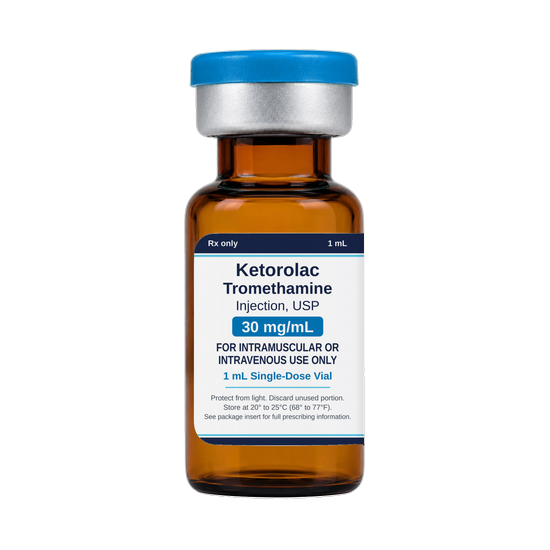
Ketorolac 30mg/mL injection (generic Toradol) for short-term management of moderately severe acute pain via IM or IV administration. Opioid-level analgesia without opioid side effects or controlled substance requirements.
Ketorolac Tromethamine — the generic form of Toradol® — is a potent injectable non-steroidal anti-inflammatory drug (NSAID) indicated for the short-term management of moderately severe acute pain requiring opioid-level analgesia. It is the only injectable NSAID approved for systemic use in the U.S., making it a clinically unique option: it provides analgesic potency comparable to moderate-dose opioids without the sedation, respiratory depression, nausea, or controlled substance requirements associated with opioid analgesics.
Ketorolac is indicated for short-term use only — not to exceed 5 days total across all routes of administration (IV, IM, and oral combined).
| Specification | Detail |
|---|---|
| Active ingredient | Ketorolac Tromethamine |
| Concentration | 30 mg/mL |
| Volume | 2 mL (60mg per vial) |
| Container | Single-dose vial |
| Route | IM or IV |
| Storage | Room temperature 20–25°C (68–77°F); protect from light |
| Therapeutic class | NSAID — injectable |
| Preservative | Refer to current product labeling |
| Prescription status | Rx only |
Contact our team for current vial availability and case quantities.
Ketorolac inhibits cyclooxygenase (COX-1 and COX-2) enzymes — the same mechanism as other NSAIDs — but produces analgesic potency at the level of moderate-dose opioids when administered by injection. COX inhibition reduces prostaglandin synthesis, which is the primary mediator of pain, inflammation, and fever at the site of tissue injury.
The injectable route produces rapid systemic absorption and onset — analgesic effect typically begins within 30 minutes of IM administration and within minutes of IV administration. This speed and potency is what distinguishes ketorolac from oral NSAIDs and positions it as a first-line non-opioid option for acute pain management in clinical settings.
Adults under 65, weight ≥50kg:
Adults 65 and older, renally impaired, or weight <50kg:
Maximum duration: 5 days total across all routes (IV, IM, and oral combined). Do not exceed 5 days under any circumstances.
Always follow the prescribing provider’s clinical protocol. Dose adjustment is required in older patients, patients with renal impairment, and patients under 50kg.
IV therapy and wellness clinics: Ketorolac is increasingly used in IV therapy settings for acute pain relief — headache (including migraine), musculoskeletal pain, and post-exertion soreness — as a non-opioid injectable analgesic that fits naturally into the IV therapy service model. Administered as an IV push into a running normal saline line or diluted into the bag.
Hangover and recovery IV protocols: Ketorolac addresses the inflammatory and pain components of hangover alongside the hydration provided by normal saline and the energy support of B-vitamins — a practical addition to recovery IV protocols for practices serving that patient population.
Post-procedure pain management: For practices performing minor in-office procedures — aesthetic, vein care, dermatologic — ketorolac provides short-term acute pain management without opioids or controlled substance prescribing.
Urgent care and primary care: Acute musculoskeletal pain, renal colic adjunct, migraine, and other acute pain presentations where rapid injectable NSAID analgesia is the appropriate clinical response.
Sports medicine and performance practices: Acute sports-related injuries and post-training inflammatory pain in patients where opioids are inappropriate, unavailable, or undesirable.
Opioid-equivalent analgesia without controlled substance burden: Ketorolac provides analgesic efficacy comparable to moderate-dose morphine for many acute pain presentations without DEA scheduling, controlled substance storage requirements, or the addiction risk associated with opioid prescribing. For practices managing acute pain without a DEA registration or without the infrastructure for controlled substance handling, ketorolac fills a meaningful clinical gap.
No respiratory depression or sedation: Patients remain fully alert after ketorolac administration — a practical advantage in outpatient and clinical settings where patients need to remain functional or drive themselves home after treatment.
Rapid onset: IM onset in approximately 30 minutes; IV onset within minutes. Appropriate for acute pain presentations where rapid relief is the clinical priority.
5-day limit as a feature, not a limitation: The strict 5-day maximum duration forces an appropriate transition plan and prevents the chronic NSAID use that drives GI and cardiovascular risk in long-term patients.
0.9% Sodium Chloride IV Bag — Ketorolac can be diluted into a normal saline bag or administered as an IV push into a running NS line. Standard pairing in IV therapy and acute pain settings.
Ondansetron Injection — Nausea is a common accompaniment to acute pain presentations. Ondansetron addresses nausea while ketorolac addresses pain — a practical two-injection combination for comprehensive symptom management in IV therapy and urgent care settings.
B-Complex Injection (Vita-Complex) — For IV therapy practices adding ketorolac to hangover and recovery protocols: B-complex addresses energy and metabolic support while ketorolac addresses inflammatory pain.
5-day maximum — strict limit: Ketorolac is contraindicated beyond 5 days across all routes combined. Extended use significantly increases gastrointestinal, renal, and cardiovascular risk. This is a hard clinical limit, not a guideline.
Gastrointestinal risk: Ketorolac can cause serious GI events including peptic ulcer, gastric bleeding, and perforation — which may occur without warning symptoms. Higher risk in older patients, patients with prior GI disease, patients on anticoagulants, and patients on concurrent corticosteroids. Use the lowest effective dose for the shortest duration.
Renal risk: NSAIDs reduce renal prostaglandin synthesis, which can precipitate acute kidney injury — particularly in patients with pre-existing renal impairment, volume depletion, heart failure, or concurrent diuretic or ACE inhibitor use. Contraindicated in patients with advanced renal impairment or at risk for renal failure due to volume depletion.
Cardiovascular risk: NSAIDs increase the risk of serious cardiovascular thrombotic events including myocardial infarction and stroke. Risk may increase with duration of use. Use with caution in patients with known cardiovascular disease or risk factors.
Bleeding risk: Ketorolac inhibits platelet aggregation and prolongs bleeding time. Contraindicated in patients with suspected or confirmed cerebrovascular bleeding, hemorrhagic diathesis, or incomplete hemostasis. Not for use in patients at high bleeding risk or undergoing major surgery.
Contraindications:
Pediatric use: Safety and efficacy in patients under 17 have not been established for the injectable formulation.
For use by or on the order of a licensed healthcare provider.
What is the maximum duration for ketorolac use?
5 days total across all routes of administration — IV, IM, and oral combined. This is a strict clinical limit. Extended use beyond 5 days substantially increases gastrointestinal, renal, and cardiovascular risk and is contraindicated.
How does ketorolac compare to opioids for acute pain?
Ketorolac provides analgesic efficacy comparable to moderate-dose opioids for many acute pain presentations — without respiratory depression, sedation, addiction risk, or DEA scheduling requirements. It is the only injectable NSAID approved for systemic use in the U.S., which is what makes it clinically unique among non-opioid analgesics.
Can ketorolac be administered IV in an IV therapy setting?
Yes. Ketorolac can be administered as a slow IV push or diluted into a compatible IV solution such as normal saline. It is commonly used in IV therapy settings for acute pain management including headache, migraine, and musculoskeletal pain.
Is a prescription required?
Yes. Ketorolac Tromethamine injectable is Rx only, available exclusively to licensed healthcare providers and medical practices.
This is a compounded medication. Compounded drugs are not FDA-approved and have not been evaluated by the FDA for safety, efficacy, or quality. This product is available by prescription only and is intended for use by or on the order of a licensed healthcare provider.

Schedule a no obligation/no-pressure call to quickly increase your weight loss clinic’s revenue.