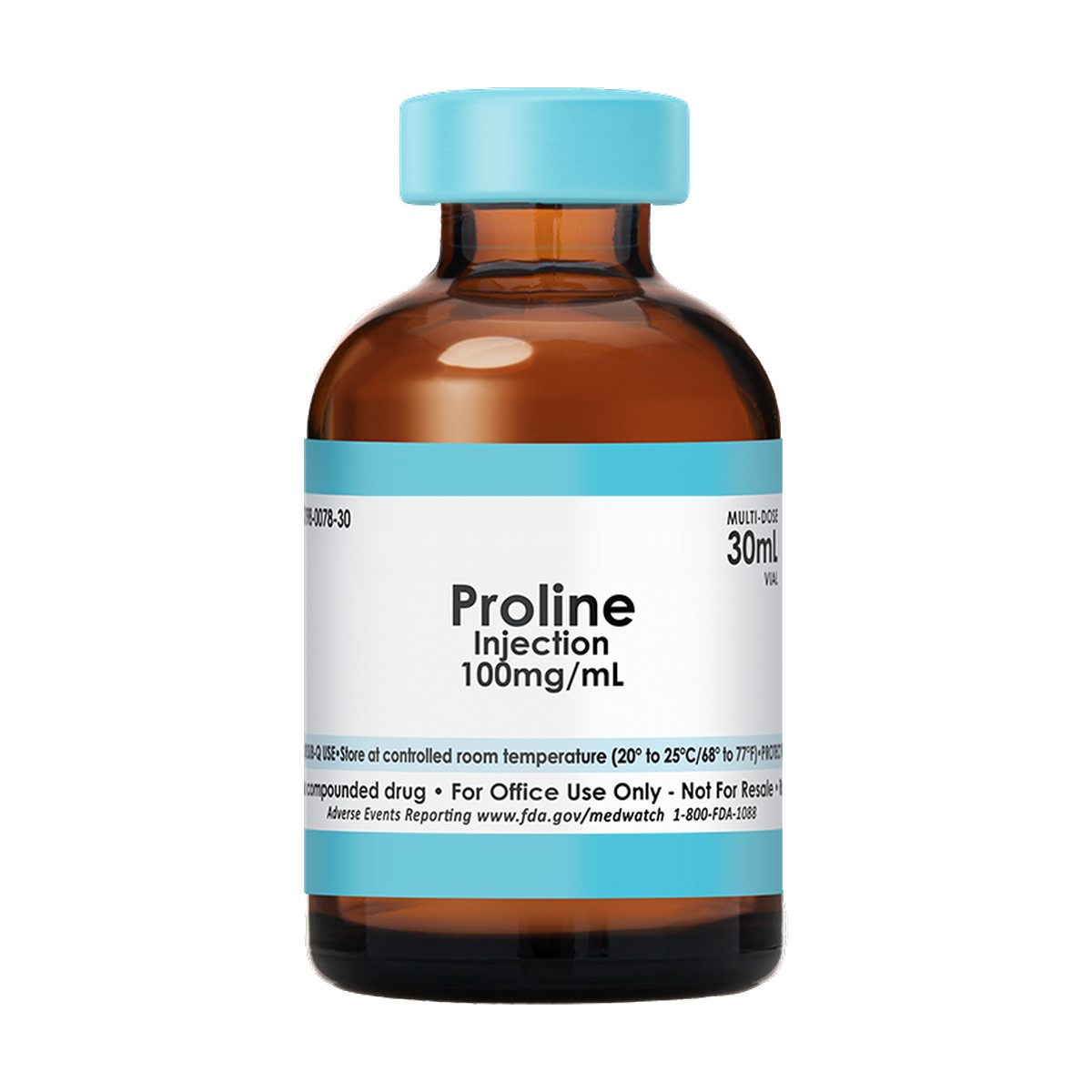
L-Proline at 100mg/mL is a primary structural building block of collagen — supporting skin elasticity, cartilage repair, wound healing, and vascular wall integrity via IV, IM, or SQ injection. The highest-concentration standalone Proline option in the catalog.
Proline is a non-essential amino acid and one of the two primary structural components of collagen — alongside Lysine. Where Lysine provides the cross-links that give collagen its tensile strength, Proline provides the repeating structural units that form the triple-helix backbone of the collagen molecule itself. Without adequate Proline, collagen production is limited regardless of other nutritional factors. At 100mg/mL via injection, standalone L-Proline delivers targeted collagen precursor support at concentrations unavailable in blend formulas.
| Specification | Detail |
|---|---|
| Active ingredient | L-Proline |
| Concentration | 100 mg/mL |
| Route | IV, IM, or SQ |
| Storage | Room temperature; protect from light |
| Product | Proline Concentration |
|---|---|
| L-Proline Injection (this product) | 100 mg/mL standalone |
| Amino Blend | 50 mg/mL (with Arginine, Carnitine, Lysine) |
| Tres Aminos | 25 mg/mL (with Arginine, Lysine) |
Choose standalone L-Proline when collagen synthesis and tissue repair are the primary clinical focus, at two to four times the concentration found in blend formulas.
Collagen structural support: Proline makes up approximately 15% of the amino acid composition of collagen — the highest concentration of any single amino acid in the molecule. It forms the repeating Gly-Pro-Hyp sequence that gives the collagen triple helix its distinctive stability and structure, supporting skin, tendons, cartilage, bone matrix, and vascular walls.
Wound healing and post-surgical recovery: At wound sites, collagen synthesis is significantly upregulated. Adequate Proline availability directly affects the rate and quality of tissue repair — particularly relevant for surgical practices, aesthetic providers, and sports medicine clinics supporting tissue recovery after procedures or injury.
Skin elasticity and integrity: As a collagen precursor, Proline supports skin structural integrity and the elasticity that declines with age-related collagen loss. A natural addition to anti-aging and skin health protocols where collagen support is the mechanism of interest.
Cartilage and joint support: Cartilage is a collagen-rich tissue with limited blood supply and slow natural repair. Proline supplementation supports the collagen substrate available for cartilage maintenance — relevant for sports medicine and orthopedic-adjacent wellness practices.
Antioxidant function: Proline participates in antioxidative reactions within the cell, contributing to the reduction of oxidative stress at the tissue level alongside its structural roles.
Precautions
Use with caution in patients with liver or kidney disease — amino acid metabolism is affected by both hepatic and renal impairment, and excessive amino acid accumulation is a risk with compromised clearance.
High doses over extended periods may cause an imbalance with other amino acids, affecting overall protein synthesis. Follow provider dosing protocols rather than self-directed supplementation.
Common side effects: Gastrointestinal discomfort, bloating, diarrhea, or stomach cramps, particularly at high doses. Allergic reactions are rare but possible — monitor for rash, itching, swelling, dizziness, or difficulty breathing.
Pregnancy and breastfeeding: effects of supplemental Proline are not fully characterized; use with caution and specialist guidance.
As a compounded Rx product, L-Proline Injection has not been evaluated by the FDA for safety, efficacy, or quality. Administer only under the supervision of a licensed healthcare provider in accordance with current clinical and state regulatory guidelines.
FAQs
Is a prescription required to order L-Proline Injection?
Yes. Available exclusively to licensed healthcare providers and medical practices.
What is the concentration and route?
100mg/mL, for IV, IM, or SQ administration.
Why use standalone L-Proline instead of a blend formula?
Standalone L-Proline at 100mg/mL provides two to four times the Proline concentration found in blend formulas, and delivers it as the sole active for protocols where collagen synthesis and tissue repair are the primary clinical focus.
What is the most important pairing for collagen support protocols?
L-Lysine and Ascorbic Acid together with L-Proline form a complete collagen synthesis protocol — Proline and Lysine are the structural building blocks, Vitamin C is the required enzymatic cofactor that incorporates them into stable collagen fibers.
This is a compounded medication. Compounded drugs are not FDA-approved and have not been evaluated by the FDA for safety, efficacy, or quality. This product is available by prescription only and is intended for use by or on the order of a licensed healthcare provider.

Schedule a no obligation/no-pressure call to quickly increase your weight loss clinic’s revenue.