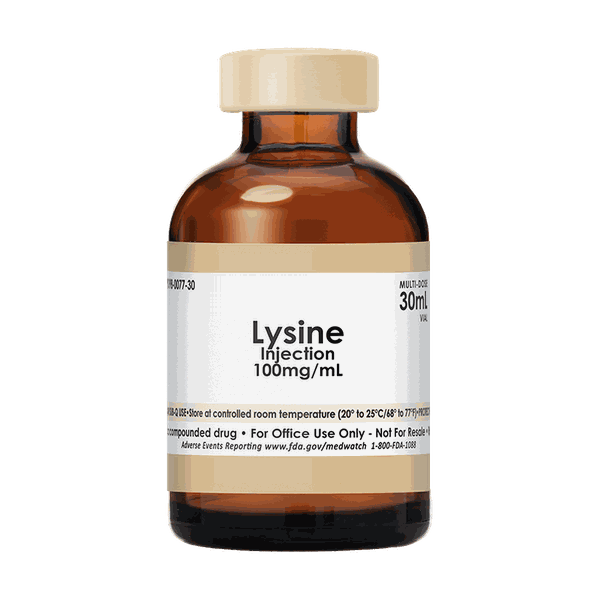
L-Lysine at 100mg/mL is an essential amino acid that supports collagen synthesis, calcium absorption, carnitine production, and immune function via IV, IM, or SQ injection. A standalone option for practices wanting targeted Lysine support beyond what multi-amino blend formulas provide.
Lysine is one of the nine essential amino acids — meaning the body cannot produce it and must obtain it through diet or supplementation. It plays a foundational role in protein synthesis, collagen production, calcium absorption, and carnitine biosynthesis. Injectable L-Lysine at 100mg/mL delivers direct systemic availability for protocols where targeted Lysine support is the clinical goal.
| Specification | Detail |
|---|---|
| Active ingredient | L-Lysine HCl |
| Concentration | 100 mg/mL |
| Route | IV, IM, or SQ |
| Storage | Room temperature; protect from light |
Lysine appears as a component in several blend formulas. The standalone injection gives practices flexibility to use it independently:
| Product | Lysine Concentration |
|---|---|
| L-Lysine Injection (this product) | 100 mg/mL standalone |
| Amino Blend | 50 mg/mL (with Arginine, Carnitine, Proline) |
| Tres Aminos | 50 mg/mL (with Arginine, Proline) |
Choose standalone L-Lysine when Lysine is the primary clinical target — collagen support, immune function, or Lysine-specific protocols — at twice the concentration found in blend formulas.
Collagen synthesis: Lysine is a required amino acid for collagen cross-linking — the process that gives collagen its structural strength and stability. Without adequate Lysine, collagen forms but lacks the cross-links that make it durable in skin, tendons, bone matrix, and vascular walls. Particularly relevant for aesthetic, post-surgical, and connective tissue support protocols.
Calcium absorption: Lysine supports intestinal calcium absorption and reduces urinary calcium excretion, helping retain calcium in the body rather than losing it through elimination. A useful addition to bone health and mineral balance protocols.
Carnitine biosynthesis: Lysine is a direct precursor to carnitine — the molecule that transports fatty acids into the mitochondria for energy production. Supporting adequate Lysine levels contributes to healthy carnitine synthesis and downstream fat metabolism.
Immune function: Lysine plays a role in T-cell development and immune response. Research has explored Lysine’s ability to compete with Arginine at the cellular level — relevant because the herpes simplex virus requires Arginine to replicate, and Lysine’s competitive action may help support a healthy viral response in susceptible patients.
Protein synthesis: As a building block for every protein in the body, Lysine directly supports tissue repair, muscle maintenance, and recovery from surgery or physical stress.
Precautions
Contraindications:
Drug interactions:
Note on Lysine and Arginine: Since Lysine competes with Arginine at the cellular level, providers using both standalone injectables in the same patient should consider the timing and clinical intent of each. This competition is therapeutically relevant in viral susceptibility contexts.
Common side effects: Diarrhea, abdominal discomfort, nausea.
Pregnancy and breastfeeding: research into injectable Lysine safety during pregnancy and lactation is limited; use with caution and specialist guidance.
As a compounded Rx product, L-Lysine Injection has not been evaluated by the FDA for safety, efficacy, or quality. Administer only under the supervision of a licensed healthcare provider in accordance with current clinical and state regulatory guidelines.
FAQs
Is a prescription required to order L-Lysine Injection?
Yes. Available exclusively to licensed healthcare providers and medical practices.
What is the concentration and route?
100mg/mL, for IV, IM, or SQ administration.
Why use standalone L-Lysine instead of a blend formula?
Standalone L-Lysine at 100mg/mL provides twice the concentration found in Amino Blend and Tres Aminos, and delivers Lysine as the sole active for protocols where collagen support, calcium absorption, or carnitine biosynthesis is the primary clinical focus.
What is the most important drug interaction to know?
Calcium supplements — Lysine significantly increases calcium absorption and reduces urinary excretion. Concurrent calcium supplementation should be carefully monitored to avoid hypercalcemia.
This is a compounded medication. Compounded drugs are not FDA-approved and have not been evaluated by the FDA for safety, efficacy, or quality. This product is available by prescription only and is intended for use by or on the order of a licensed healthcare provider.

Schedule a no obligation/no-pressure call to quickly increase your weight loss clinic’s revenue.