Updated February 25, 2026; Original post date: September 5, 2018. Written by Jon Legere.
NAD+
Nicotinamide adenine dinucleotide (NAD+) is a vital coenzyme present in every cell of the body, serving as a central player in cellular energy production, metabolism, and overall health. Beyond its classic role in energy metabolism, NAD+ acts as a crucial co-substrate for several key enzyme families that regulate essential cellular processes.
NAD+ levels naturally decline with age, contributing to impaired mitochondrial function, reduced energy production, accumulated cellular damage, chronic inflammation, and metabolic dysfunction. It’s linked to many hallmarks of aging and age-associated conditions, such as cognitive decline, sarcopenia (muscle loss), metabolic disorders, cardiovascular issues, and frailty.
This is why NAD+ has become a focal point in longevity research, with precursors like nicotinamide (NAM), nicotinamide riboside (NR), and nicotinamide mononucleotide (NMN) explored for their ability to boost NAD+ and counteract these declines.
What is B3?
- Niacin (nicotinic acid)
- NAM (niacinamide/nicotinamide)
- NR (Nicotinamide Riboside)
- NMN (Nicotinamde Mononucleotide)
The traditional form of B3 is Niacin. That is the form found in foods such as yeast, meat, fish, milk, eggs, green vegetables, and cereal grains. Nicotinamide (NAM), also known as niacinamide, is the form of vitamin B3 usually found in dietary supplements and medications. Recently two new forms of B3, Nicotinamide Riboside (NR) and Nicotinamde Mononucleotide (NMN), have entered the limelight for their ability to promote longevity and good health. The companies which promote these ingredients showcase various studies that illustrate their benefits but leave out vital information such as how the ingredients are administrated and where the results are being measured. Such studies have mostly been done in single-celled organisms and there is no reliable data to show that it is true in case of humans.
In fact, more recent studies have demonstrated that orally ingested nicotinamide riboside (NR) and nicotinamide mononucleotide (NMN) get almost entirely converted to nicotinamide (NAM) in the liver: “Intravenous administration of nicotinamide riboside or mononucleotide delivered intact molecules to multiple tissues, but the same agents given orally were metabolized to nicotinamide in the liver” (Liu, 2018). “Thus, the majority of the orally administered NR that reaches the muscle appears to enter in the form of liberated NAM. […] NR exerts only a subtle influence on the steady-state concentration of NAD in muscles” (Frederick, 2016).
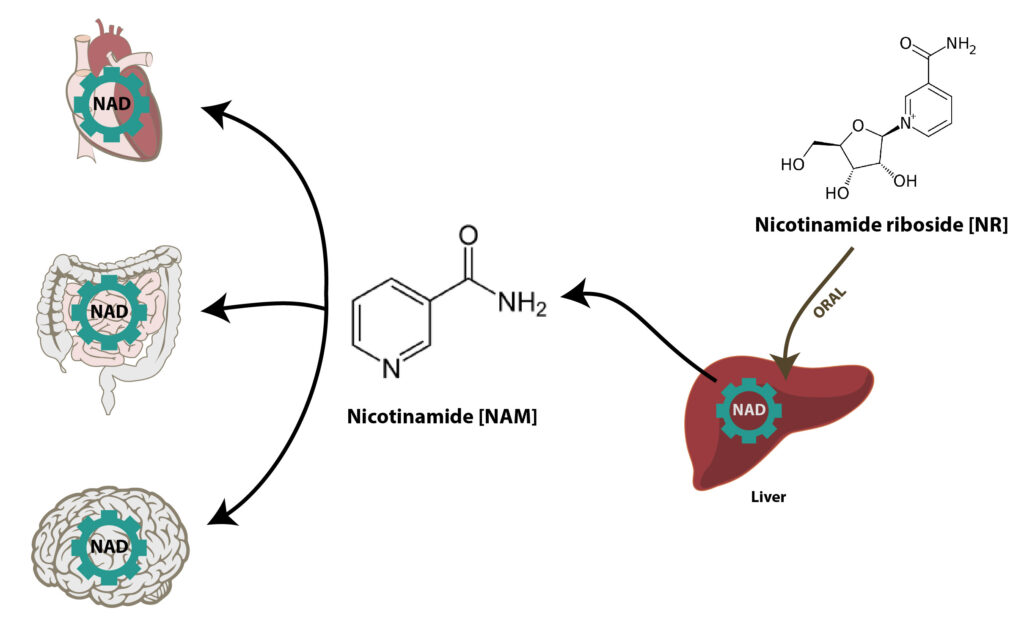
Therefore, while NR or NMN may cause NAD levels to increase in the liver, the increase in NAD measured in other tissues and attributed to NR or NMN supplementation is actually caused by an increase of nicotinamide (NAM).
This suggests that a sublingual nicotinamide, by skipping the biological conversions that take place in the liver, would be more effective for increasing NAD than any form of B3 taken orally.
What do the studies say?
A nonrandomized study of single oral supplementation within the daily tolerable upper level of nicotinamide affects blood nicotinamide and NAD+ levels in healthy subjects.
In a study from 2019, 200 mg of NAM was orally administered with water at 9 a.m. Blood samples were collected before (0 h) and 0.5, 1, 2, 3, 4, 6, 8, 10, 12, 24, and 48 h.
The same meals were provided to all participants for lunch and dinner. The meals provided avoided meats and ingredients containing high levels of vitamin B3 and mainly consisted of vegetables, fruits, seafood, rice, and bread. Otherwise, only water was allowed to be consumed, meaning the diet was completely controlled prior to and after NAM supplementation.
Study Outcomes:
Effective Increase in NAD+ Levels: The study demonstrated that a single oral dose of nicotinamide within the daily tolerable upper level (200 mg) significantly increased blood NAD+ levels. The maximum concentration of NAD+ was observed at 12 hours post-administration, with a consistent trend of increase across all time points measured.
Rapid Increase in Blood Nicotinamide: After ingestion, there was a 30-fold increase in blood nicotinamide concentration at 0.5 hours, which then decreased consistently until 6 hours. This indicates that nicotinamide is quickly absorbed into the bloodstream.

A 2017 in vitro experimental lad study of NAM administration.
Researchers used various biochemical and molecular biology techniques, such as flow cytometry, confocal microscopy, Western blot analysis, and oxygen consumption rate (OCR) measurements, to investigate the effects of nicotinamide (NAM) on mitochondrial function.
Study Outcomes:
Increase in NAD+/NADH Ratio: NAM treatment led to an increase in the NAD+/NADH ratio in both the cytosol and mitochondria. The mitochondrial NAD+/NADH ratio increased more significantly than the cytosolic ratio.
References:
Liu, L., Su, X., Quinn, W., et. al. (2018). Quantitative Analysis of NAD Synthesis-Breakdown Fluxes. Cell Metabolism:27(5).
Frederick, D., Loro, E., Liu, L., et. al. (2016). Loss of NAD Homeostasis Leads to Progressive and Reversible Degeneration of Skeletal Muscle. Cell Metabolism:24(2).
Rennie, G., Chen, A., Dhillon, H., Vardy, J., Damian D. (2015). Nicotinamide and neurocognitive function. Nutritional Neuroscience:18(5).
Takashi K. Ito, Tomohito Sato, Akio Hakamata, Yuki Onoda, Shumpei Sato, Fumiyoshi Yamazaki, Makoto Horikawa, Yutaka Takahashi, Takuya Kitamoto, Masako Suzuki, Shinya Uchida, Keiichi Odagiri, Mitsutoshi Setou, A nonrandomized study of single oral supplementation within the daily tolerable upper level of nicotinamide affects blood nicotinamide and NAD+ levels in healthy subjects, Translational Medicine of Aging, Volume 4, 2020, Pages 45-54.
Song, Seon Beom, Jang, So-Young, Kang, Hyun Tae, Wei, Bie, Jeoun, Un-woo, Yoon, Gye Soon, & Hwang, Eun Seong. “Modulation of Mitochondrial Membrane Potential and ROS Generation by Nicotinamide in a Manner Independent of SIRT1 and Mitophagy.” Molecules and Cells, vol. 40, no. 7, July 2017, pp. 503-514. https://doi.org/10.14348/molcells.2017.0081.
For informational purposes only. Not medical advice. Consult your healthcare provider before starting any supplement.